

Search for “passive income with AI” and you will find a familiar script: money arriving while you sleep, no effort required. Here is the honest version: AI does not remove work from the equation — it changes the kind of work. You trade concentrated effort upfront for income that arrives later, sometimes with very little ongoing effort.
In this article
- What “passive income with AI” realistically means
- 7 realistic ways to build passive income with AI in 2026
- Comparing the 7 ideas side by side
- How to choose your one lane
- Mistakes that kill most beginners
- Your first 90 days
- Passive Income with AI: Frequently Asked Questions
- The Bottom Line on Passive Income with AI
- Sources and Further Reading on AI and Passive Income
- Article updates
That is a real shift. AI has collapsed the cost of creating things that once needed a team: polished templates, clear ebooks, striking images, working automations. A beginner pursuing passive income with AI can now produce in a weekend what once took a month. But creation was never the whole game — distribution, trust, and positioning decide whether anything sells, and no model can buy those for you.
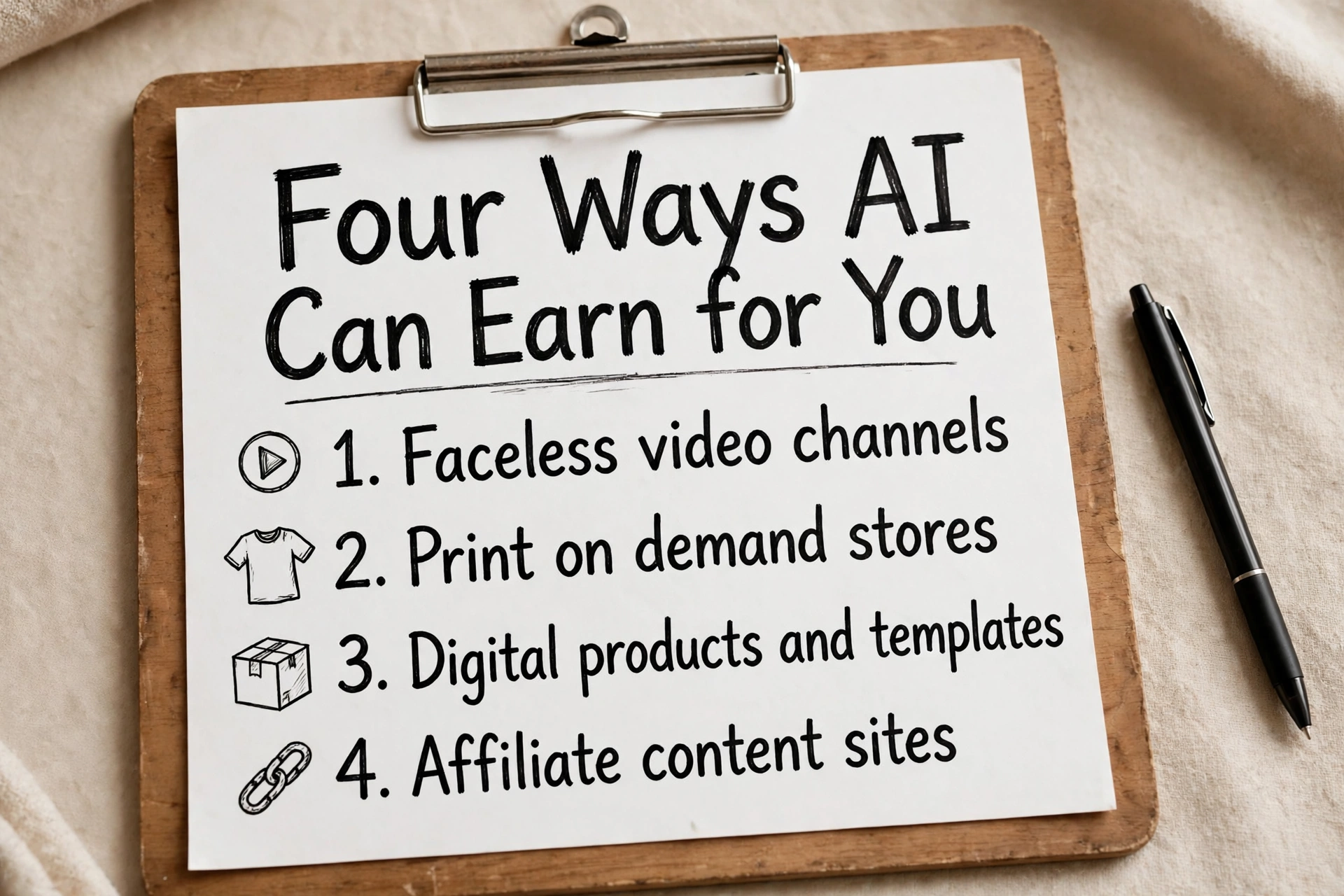
This guide covers seven realistic ways to build passive income with AI in 2026 — cost, time to first dollar, honest earning range, and who each suits, ordered on a passivity spectrum. One rule governs all of it: pick a single lane and give it ninety days.
What “passive income with AI” realistically means
Retire the fantasy version of the phrase first: almost nothing is truly passive. Every income stream sits somewhere on a spectrum, and knowing where yours sits keeps expectations honest.
Digital products, licensed stock assets, ad revenue on old content. Ongoing work is minutes per week — the odd support email, a listing refresh — after weeks of focused building before the first sale.
Semi-passive. Affiliate blogs, newsletters, courses. The asset earns around the clock but needs feeding — new posts, updates, audience care. A few hours a week, indefinitely; neglect it for a season and it decays.
Active income with leverage. Selling automation builds or AI-assisted services. AI multiplies what one person can deliver, but clients still expect you to show up. The path to passivity is productization — turning custom work into repeatable packages and retainers.
AI’s real contribution to passive income with AI is moving work earlier: from ongoing production to upfront design. You build once, earn repeatedly, and maintain instead of remaking. That is as close to passive as honestly exists.
7 realistic ways to build passive income with AI in 2026
Each idea covers cost, time to first dollar, earning range, and who it suits — ordered most passive to least. Treat every range as potential, not a promise — actual timelines and results vary widely.
Disclosure: Some links in this article may earn Dear Thoughts a commission if you buy through them, at no extra cost to you. No company pays for placement — our rankings and verdicts are editorial.
1. Sell AI-assisted digital products: templates, prompt packs, and ebooks
What it is: a digital asset you create once — a Notion template pack, refined prompts, a short practical ebook, a spreadsheet system — sold repeatedly on marketplaces like Gumroad or Etsy. AI accelerates drafting, formatting, and cover design — the core leverage of passive income with AI; the value comes from your judgment in solving one specific problem well.
Startup cost: near zero — Gumroad is free to start and Etsy charges small listing fees. Time to first dollar: two to six weeks with a specific audience and a simple launch. Realistic earning potential: some sellers with traction report $300 to $5,000 per month, usually across several products, not one hit — though results vary widely depending on niche, effort, and timing.
Who it suits: writers, designers, and planners who can package a system that works. Budget five to ten focused hours per product.
2. Build an AI-assisted affiliate niche blog
What it is: search-optimized articles — comparisons, tutorials, honest reviews of software and tools — earning through affiliate commissions and display ads. AI speeds up research, outlining, and first drafts, which is why passive income with AI blogging attracts patient writers — but ranking requires genuine usefulness: real testing, honest opinions, depth a generic article cannot fake.
Startup cost: low — a domain and basic hosting run roughly $50 to $150 per year (estimates as of October 2026; prices vary by provider). Time to first dollar: six to twelve months of consistent publishing; search engines trust sites that prove themselves over time. Realistic earning potential: some established niche blogs report $500 to $8,000 per month from affiliates and ads — though most earn far less, and results vary widely.
Who it suits: patient writers who enjoy research: three to five hours a week, indefinitely. If six months of publishing before results sounds unbearable, skip it — for those who stay, it is one of the most durable passive income with AI options here.
3. Print-on-demand with AI design help
What it is: designs — with AI image tools doing the heavy lifting on artwork — sold on shirts, mugs, and posters through platforms that handle printing and shipping. You never touch inventory.
Startup cost: low — most platforms are free to list on. Time to first dollar: one to three months, often in trickles. Realistic earning potential: modest for most beginners — this is the most crowded lane, and generic designs drown. Earnings concentrate with sellers who pick a sharp niche, like a hobby or profession, and publish consistently good work for that audience.
Who it suits: people with visual taste and niche knowledge. If you understand a specific community’s humor and references better than most, you hold an edge no tool can replicate. As a passive income with AI lane, it rewards taste over volume.
4. Sell AI automation workflows to small businesses
What it is: practical automations — follow-up sequences, chatbots, invoicing and scheduling workflows built with tools like Zapier or Make — sold as packaged setups to small businesses with a monthly maintenance retainer. The least passive idea here, but AI agents now let one person’s output resemble a small agency’s.
Startup cost: low — automation tool subscriptions typically run roughly $10 to $50 per month, depending on the tool and plan — see Zapier’s pricing and Make’s pricing (figures as of October 2026; check the official pages for current details). Time to first dollar: two to eight weeks to a first paying client with consistent outreach. Realistic earning potential: project fees plus retainers can grow into a full-time income, but it stays active work until you productize builds into repeatable packages.
Who it suits: tinkerers who like talking to business owners. If you are starting freelancing, this is a natural high-value service to add — and our beginner’s guide to AI agents is a useful primer on the underlying technology.
5. Grow an AI-assisted newsletter or content channel
What it is: an audience built around a topic — a newsletter, a faceless video channel, a short-form series — with AI assisting research, scripting, editing, and production — a classic passive income with AI setup once the audience exists. Revenue arrives later: sponsorships, affiliates, products, memberships.
Startup cost: near zero — a newsletter platform’s free tier or a phone camera is enough. Time to first dollar: six to twelve months at minimum. Realistic earning potential: small for a long time, then compounding for the few that break through — diversify if yours does.
Who it suits: consistent creators who enjoy the topic itself, because the topic must carry you through months of low numbers. Do not start a channel about something boring because someone called the niche profitable.
6. Record an online course or workshop once, sell it repeatedly
What it is: teaching something you know — a work skill, a creative process, a software workflow — recorded once and sold on a course platform or your own site. AI helps with outlines, slide drafts, quizzes, and polishing transcripts into lessons — the standard passive income with AI toolkit for course creators.
Startup cost: low to moderate — a decent microphone matters more than a camera; platforms take a revenue share. Time to first dollar: one to three months from recording to first sales, assuming a small audience to launch to. Realistic earning potential: wide — a focused course for a specific professional audience can earn steadily for years, while a generic one in a saturated topic may barely sell.
Who it suits: people with a teachable skill and the patience to plan a curriculum. If colleagues already ask how you do things, you may be sitting on a passive income with AI course.
7. License stock-style AI assets: images, music, and voice
What it is: large volumes of usable stock assets — background images, ambient music tracks, voiceover clips — licensed through stock libraries that pay per download or subscription share. Generation tools make the passive income with AI volume game possible; curation makes it valuable.
Startup cost: low — generation subscriptions and library accounts. Time to first dollar: three to six months; libraries review submissions and payouts accumulate slowly. Realistic earning potential: modest per asset — a volume game where portfolios of hundreds of quality assets produce steady trickles, and small scattered ones earn almost nothing.
Who it suits: prolific producers who enjoy generating and curating. Treat it as a slow-building side stream, not a primary plan.
Comparing the 7 ideas side by side
The passive income with AI trade-offs at a glance — “weekly time after launch” is the maintenance load once the asset exists; the upfront build always costs more.
| Idea | Startup cost | Weekly time after launch | Earning potential |
|---|---|---|---|
| AI digital products | Near zero | 1–2 hours | $300–$5,000/mo at traction |
| Affiliate niche blog | $50–$150/yr | 3–5 hours | $500–$8,000/mo at scale |
| Print-on-demand | Near zero | 2–4 hours | Modest; niche-dependent |
| AI automation services | $10–$50/mo | 10+ hours (active) | High; projects + retainers |
| Newsletter / content channel | Near zero | 5–10 hours | Slow, then compounding |
| Online course | Low–moderate | 1–2 hours | Wide; audience-dependent |
| Stock AI assets | Low | 3–5 hours | Modest; volume game |

How to choose your one lane
Score each idea from 1 to 5 on three questions, then start with your highest total.
Skills. What can you already do? Writers lean toward blogs, newsletters, ebooks, and courses; visual thinkers toward print-on-demand and stock assets; problem-solvers toward automation services. Do not pick a lane that requires you to become a different person first.
Capital and runway. What can you spend, and how long can you wait? Near-zero-cost lanes suit tight budgets. If you need money within two months, automation services are the honest answer — active work, but it funds everything else.
Patience and temperament. Can you publish for six months with little feedback? Blogs and channels demand it. Need early wins to stay motivated? Digital products and automation clients give faster signals.
Then commit: one lane, ninety days, no switching — the golden rule of passive income with AI. You may stack deliberately — services by day while a product compounds in the background — but one lane gets your best hours. Before locking in, check our roundup of AI tools that replace hours of manual work covers the apps most of these lanes run on.
Mistakes that kill most beginners
Beginners rarely fail for lack of tools. They fail in predictable, avoidable ways.
Shiny-object hopping. Trying a new lane every two weeks means few ever get the time to mature. Ninety days, one lane — boredom is part of the process.
No distribution plan. Building the product is half the job. Decide where buyers already gather — marketplaces, search, communities — before you build.
Ignoring SEO. For blogs, products, and courses alike, search is the free distribution engine that compounds — and SEO is the highest-leverage skill in passive income with AI. Learn the basics or stay invisible.
Underpricing. Beginners price digital products at a tenth of their value. Price for the problem solved, not the hours spent — buyers pay for outcomes.
Publishing AI slop. Readers and platforms punish generic, unedited AI output. Use AI for speed; add the judgment only you can provide.
Your first 90 days
A week-by-week passive income with AI starter rhythm — adjust the lane details, keep the cadence.
Weeks 1–2: research and choose. Study three sellers succeeding in your lane — pricing, positioning, traffic sources — and pick your niche narrowly: “Notion templates for freelance designers” beats “productivity templates.”
Weeks 3–4: build the minimum viable asset. One product, ten articles, twenty designs, one service package — whatever version one means. Ship it imperfect; perfection is procrastination in nicer clothes.
Weeks 5–8: distribution first. Spend at least half your weekly hours on distribution: SEO basics, marketplace optimization, outreach, community participation. An asset nobody finds earns nothing.
Weeks 9–12: measure and iterate. Look at real data: which product gets views, which article ranks, which outreach gets replies. Double down on what shows a pulse; fix or drop the rest. At day ninety, decide with evidence whether to continue, adjust, or switch lanes — once.
Passive Income with AI: Frequently Asked Questions
Short answers to the questions every beginner asks.
How much money do I need to start?
Less than most people assume. Four of the seven ideas start at near zero — free marketplace accounts, newsletter tiers, and tool plans. The most capital-hungry, an affiliate blog, needs roughly $50 to $150 for a year of domain and hosting (estimates as of October 2026; prices vary by provider). The real budget is time: every lane demands upfront hours no tool skips.
How long until I earn anything?
Anyone promising one timeline for all seven is selling something. As rough orientation only — timelines vary widely — some people report first dollars in two to eight weeks for automation services and digital products; one to three months for print-on-demand and courses; three to six months for stock assets; six to twelve months for affiliate blogs and channels. Meaningful, repeatable income typically takes about twice as long — the standard passive income with AI timeline.
Do I need technical skills for passive income with AI?
No. Most lanes need comfort with everyday software, not code. Writing clear prompts, organizing information, and learning one platform deeply matter far more than programming. The automation lane rewards light technical curiosity, but modern no-code tools have made it accessible to determined beginners.
Is AI-assisted content allowed on marketplaces and platforms?
Generally yes, with disclosure rules that keep evolving. Amazon KDP, stock libraries, and content platforms each publish AI policies — some require labeling AI-generated work, and all penalize low-quality spam however it was made. Check a platform’s current policy before investing weeks building for it, and keep your prompts and project files as evidence of your process.
Can AI really make income passive, or is that a myth?
A half-truth. AI genuinely reduces labor per unit of output — that part is real. What it cannot do is choose a good niche, earn trust, or distribute your work. Think of AI as leverage on good decisions, not a replacement for them. The people earning passive income with AI worked intensely upfront and maintain lightly now. That is the honest deal, and it is still a good one.
The Bottom Line on Passive Income with AI
Passive income with AI is real, but it is earned twice: once in the building, and again in the patience to let assets compound. The tools have never been cheaper — so the differentiator was never the tool. It is your niche’s specificity, your judgment, and the discipline to stay in one lane for ninety days.
Pick the passive income with AI idea that fits the skills you already have and the runway you can afford. Build the smallest version that could work. Then distribute it like your income depends on it — because it does.
Sources and Further Reading on AI and Passive Income
- Best AI Tools for Passive Income in 2026 That Actually Pay — Complete Guide (Medium) — a practical companion roundup mapping AI tools to income strategies.
- Related on Dear Thoughts: 10 AI tools that replace hours of manual work, how to start freelancing in 2026, and a beginner’s guide to AI agents.
Article updates
- October 13, 2026 — Credibility review: added official sources for pricing, fees, and platform policies; softened absolute claims.



[…] if you’re thinking about income streams rather than client work, agents slot naturally into passive income with AI setups: content pipelines, research products, and automated storefront operations that run while […]
[…] For niche products with good SEO, yes — Etsy’s buyer intent is extremely high (people arrive ready to buy gifts). It’s not passive at the start, but established shops with strong reviews earn semi-passively, similar to the realistic models in our passive income guide. […]
[…] On both: treating the platform as the business. Algorithm changes, account reviews, and fee hikes happen. The freelancers who last build direct client relationships and an email list alongside their platform income — the same diversification logic behind building passive income streams with AI in 2026. […]
[…] month the customer stays. If you create content about learning new skills, this lane overlaps with passive income ideas built with AI, another model that rewards assets over […]
[…] Semi. Designs you uploaded a year ago can still sell while you sleep — that’s the passive part. But staying competitive means regularly adding new designs, which is active work. Think of it as front-loaded effort with a long tail, like the realistic models in our passive income with AI guide. […]
[…] many creators earn more from sponsorships, affiliate links, and their own products. Our guide to passive income with AI covers digital-product ideas that pair well with a channel, and a blog alongside your channel gives […]
[…] 5. Check your Payment account regularly. Shop Manager → Finances → Payment account shows every fee broken down per order. Review it monthly. The fee you didn’t know existed is always the one that costs you, and this page is where you see Offsite Ads charges, currency conversion hits, and regulatory fees before they surprise you. Selling digital products is also one of the routes in our guide to passive income with AI. […]
[…] is a machine you can monetize five ways, which is why blogging remains one of the more realistic passive income ideas for patient beginners — though results vary widely by niche and effort. Wondering whether writing […]
[…] one of those income streams is yours. We explored the AI-assisted version of this in our piece on passive income with AI — the principle is the same with or without […]