
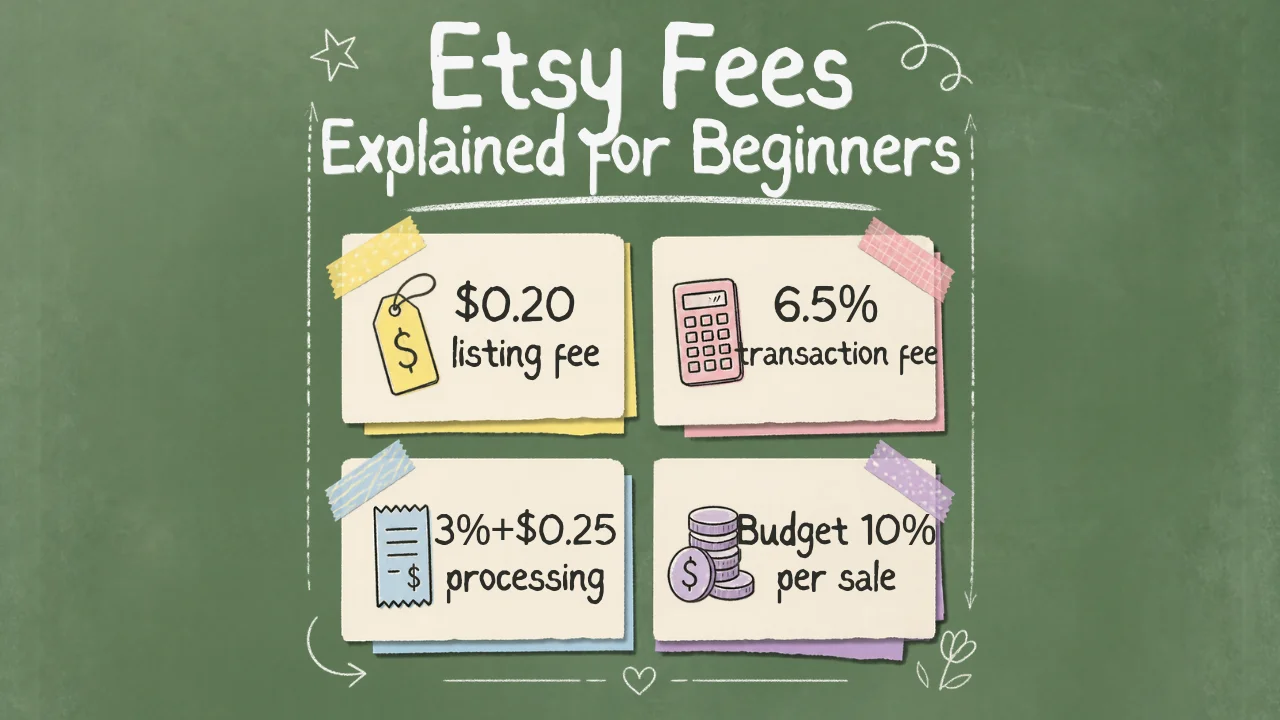

Etsy fees explained for beginners in plain numbers: as a beginner, expect to give Etsy roughly 10–11% of every sale — a $0.20 listing fee, a 6.5% transaction fee, and a payment processing fee of about 3% plus $0.25 on US orders. That is the part nobody tells you when they quote the “6.5%” headline, and it is why so many new sellers misprice their first products. This guide walks through every fee Etsy charges in 2026, shows what each one costs on real sales, and ends with the only fee decisions a beginner actually needs to make.
In this article
One orientation note before the numbers: Etsy does not charge one fee. It charges a stack of them, and each one hits at a different moment — some before you sell anything, some per order, some only if you opt into a feature. The sellers who get surprised are the ones who planned for 6.5% and met the other three at the checkout. Read this once and you will price like someone who has been selling for a year.
Etsy fees at a glance
| Fee | Rate | When it hits | Avoidable? |
|---|---|---|---|
| Listing fee | $0.20 | When you publish or renew a listing | No |
| Transaction fee | 6.5% | Every sale, on item price + shipping + gift wrap | No |
| Payment processing (US) | 3% + $0.25 | Every sale, on the buyer’s total | No (rate varies by country) |
| Offsite Ads | 15% (12% once your shop passes $10k/year) | Only when Etsy ran an ad that led to the sale; capped at $100 per order | Yes, while your shop is under $10k |
| Currency conversion | 2.5% | Only when your listing currency differs from your payout currency | Yes — align your currencies |
| Regulatory operating fee | Varies (0.05–1.67% depending on country) | Per sale, in certain countries | No |
| Etsy Plus | $10/month | Optional subscription | Yes |
| Pattern | $15/month | Optional website builder | Yes |

The 3 fees every sale pays
1. The $0.20 listing fee — the only fee you pay before selling anything
$0.20 per listing; charged whether or not the item sells · help.etsy.com
This is the smallest fee and the one that catches people off guard for the most boring reason: it is paid upfront. Every listing costs $0.20 the moment you publish it, whether or not anyone ever buys. Listings expire after 4 months, and when a listing auto-renews, you pay another $0.20. Sell one unit from a multi-quantity listing and you pay $0.20 again for the next unit that becomes available.
The math that matters here is inventory math, not sale math. A shop with 100 listings pays $20 every four months just to keep existing — $60 a year for the privilege of having listings sit there. That is completely reasonable if 100 listings drive your traffic. It is a quiet money leak if 90 of them never get a view.
Practical rule: don’t let dead listings auto-renew forever. If a listing has sat for two renewal cycles with no views or sales, either fix it (photos, title, SEO) or deactivate it. The fee is small; the discipline is the point.
2. The 6.5% transaction fee — the headline, and not the whole story
6.5% of the total order amount, including shipping and gift wrapping · help.etsy.com
This is Etsy’s core commission, and it has been 6.5% since April 2022. The detail most beginners miss: it is charged on the total the buyer pays for the item plus whatever you charge for shipping and gift wrapping. You cannot reduce it by moving cost from the item price into postage. An $80 item with $20 shipping pays exactly the same transaction fee as a $100 item with free shipping — 6.5% of $100 either way.
Two honest observations about this fee. First, it is non-negotiable. Every sale on Etsy pays it — no volume discounts, no exemptions, no way around it. Second, shipping being included is genuinely the fairer design. On platforms where the commission only applies to the item price, sellers inflate shipping to dodge fees and buyers get burned. Etsy closed that loophole, which is good for buyers and predictable for you.
3. Payment processing — the fee people confuse with the transaction fee
3% + $0.25 per order for US sellers; charged on the buyer’s total including shipping · help.etsy.com
Etsy Payments is what processes the buyer’s card, and it takes its own cut separately from the 6.5% transaction fee. For US sellers that is 3% of the order plus a flat $0.25 per order. Rates differ by country — the UK and most of the EU run higher percentages — so if you are not US-based, check the payment processing page for your country’s rate before you do any of the math in this article.
The $0.25 flat charge is the part worth thinking about, because flat charges punish cheap items. On a $4 sticker, the $0.25 alone eats over 6% before any percentage is applied. On a $100 order, it is a rounding error. This is the entire argument against selling very cheap items on Etsy: the flat components don’t shrink. If your niche is stickers or small supplies, bundling items into higher-value listings or orders pushes the effective rate down a lot.
What the three fees look like on real sales
| $25 item, no shipping | $50 item, $6 shipping | $100 digital download, no shipping | |
|---|---|---|---|
| Listing fee | $0.20 | $0.20 | $0.20 |
| Transaction fee (6.5%) | $1.63 | $3.64 | $6.50 |
| Payment processing (3% + $0.25) | $1.00 | $1.93 | $3.25 |
| Total Etsy fees | $2.83 | $5.77 | $9.95 |
| Effective rate | 11.3% | 10.3% | 9.95% |
See the pattern: Etsy’s headline fee is 6.5%, but the fee you actually pay is closer to 10% — and cheaper items lose a bigger share. That 10% rule of thumb is what you should price against, not the 6.5%. Digital products come out best in this math: no shipping to pay transaction fees on, no materials to eat into what is left, so nearly everything after that 10% is yours.
A note on the processing column: these use US rates. If you are in Pakistan, the UK, or the EU, your processing percentage will differ — the listing and transaction fees stay the same worldwide, the processing fee doesn’t.
The optional fees (and the one that surprises people)
Offsite Ads — the 15% you never signed up for
15% of the order total if your shop made under $10,000 in the last 365 days; 12% if over; never more than $100 per order · help.etsy.com
Offsite Ads is Etsy advertising your products on Google, Facebook, and other platforms. When a buyer purchases within 30 days of clicking one of those ads, Etsy takes an extra 15% of the order total. And here is the part that surprises people: you are enrolled automatically. You never clicked anything, never set a budget, never chose to run ads — it just happens.
If your shop has made less than $10,000 in the trailing 365 days, you can turn it off in Shop Manager → Settings → Offsite Ads. If your shop has made $10,000 or more, enrollment is permanent and you cannot opt out — you just get the lower 12% rate.
My honest take for beginners: turn it off while you can, unless you can prove it pays. Offsite Ads charges a flat 15% regardless of your margin. On a product with a 20% margin after all other costs, an Offsite Ad sale leaves you almost nothing. Big-volume sellers can absorb it as a customer acquisition cost. Beginners almost never should. Opt out, then decide later with data.
Currency conversion — 2.5%, avoidable in one step
2.5% when your listing currency differs from your payout currency · help.etsy.com
If you list in USD but your payment account is in a different currency, Etsy converts your funds and takes 2.5% for the conversion. The fix is simple: list in the currency of your payment account. This fee never has to happen.
Regulatory operating fee — small, location-dependent
Charged on the order total in certain countries; e.g. UK 0.48%, France 1.14%, Italy 0.80%, Spain 0.88%, Türkiye 1.67%, India 0.05%, Canada 0.50%, Vietnam 1.24% · help.etsy.com
This covers the cost of doing business where new digital regulations raised Etsy’s costs. If your country isn’t on the list, ignore it. If it is, factor the percentage into pricing — it is small, but on thin margins it is not nothing. Note these rates were updated in mid-2026, so treat them as current as of late 2026 and check the page before relying on them for pricing.
The shop set-up fee — one-time, varies by location
Etsy charges a one-time, non-refundable fee when you open a new shop, introduced to verify identity and cut down on spam shops. The amount varies by country and is shown to you during the set-up process, before you commit. It is a startup cost, not an ongoing fee — budget for it once and forget it.
Etsy Plus and Pattern — the subscriptions beginners should skip
Etsy Plus: $10/month. Pattern: $15/month after a 30-day free trial · help.etsy.com
Etsy Plus gives you listing and ad credits plus extra shop customization. Pattern is Etsy’s own standalone website builder for sellers who want a site beyond the marketplace. Both are fully optional — no part of selling on Etsy requires them, and you can run a profitable shop indefinitely without either.
Beginner guidance: don’t pay for either until the revenue justifies it. Etsy Plus’s $10/month makes sense when the included listing credits (15 a month) offset renewals you would pay anyway and you actually use the customization tools. Pattern’s $15/month makes sense when you have repeat buyers who would rather purchase from your own site — which is a later-stage problem. In your first months, every dollar is better spent on product photos and more inventory.
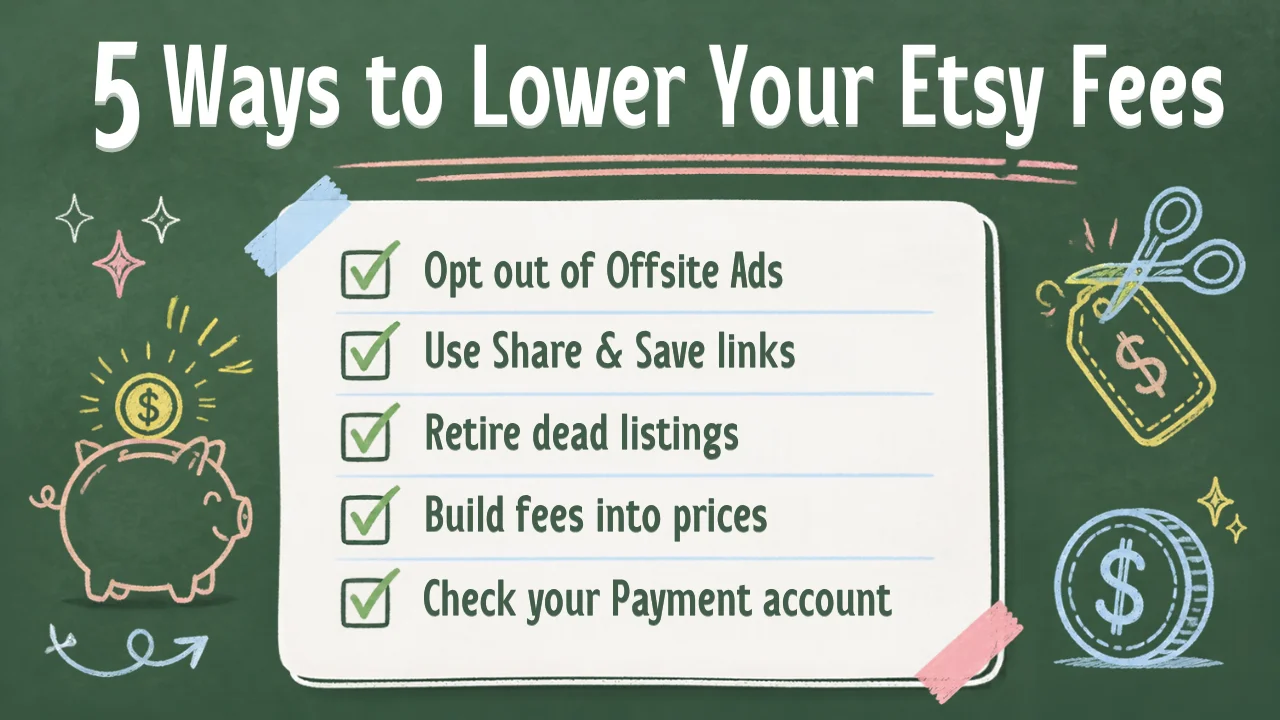
5 ways beginners actually lower their Etsy fees
1. Opt out of Offsite Ads while you can. Under $10,000 in trailing-365-day sales, go to Shop Manager → Settings → Offsite Ads and switch it off. That 15% is the single biggest controllable cost on this list. Revisit it only when your margins can carry it.
2. Use Share & Save. When you drive traffic yourself — Instagram, Pinterest, your YouTube channel — generate a trackable Share & Save link in Shop Manager → Marketing. Sales through those links refund 4% of the order total, dropping your effective transaction fee from 6.5% to 2.5% on that sale. It costs nothing to join, and for sellers who promote off Etsy it is the cheapest fee cut available.
3. Deactivate listings that aren’t earning. Every listing costs $0.20 per four-month renewal. A shop with 200 listings where 150 get zero traffic pays $30 per renewal cycle for nothing. Either improve those listings (photos and SEO first) or turn them off. Fewer, better listings beat a bloated catalog twice over.
4. Build the fees into your prices. Do the opposite of absorbing costs. If your real costs plus a 10% fee allowance say the price should be $34, list at $34. Etsy shoppers are comparing you against other handmade or vintage sellers who face the same fees — you are not overpricing by being honest about costs, you are staying in business.
5. Check your Payment account regularly. Shop Manager → Finances → Payment account shows every fee broken down per order. Review it monthly. The fee you didn’t know existed is always the one that costs you, and this page is where you see Offsite Ads charges, currency conversion hits, and regulatory fees before they surprise you. Selling digital products is also one of the routes in our guide to passive income with AI.
FAQs
How much does Etsy take from a $100 sale?
A US seller with no shipping and no Offsite Ads pays about $9.95 — $0.20 listing, $6.50 transaction fee, $3.25 payment processing — roughly 10%. With shipping, add the shipping amount to the 6.5% and 3% calculations. With an Offsite Ad sale, add another 15% ($15) or 12% ($12) if your shop is over $10k, pushing the total to 22–25% of the order.
Does Etsy charge fees on shipping?
Yes. The 6.5% transaction fee applies to the item price plus whatever you charge for shipping and gift wrapping — not just the item price. That is why raising shipping to lower the item price never reduces your fees. Digital downloads avoid this entirely since there is no shipping.
Are there monthly fees to sell on Etsy?
No mandatory ones. Opening a shop is free apart from the one-time set-up fee and the $0.20 per listing. Etsy Plus ($10/month) and Pattern ($15/month) are optional subscriptions you can skip completely.
Can beginners avoid the Offsite Ads fee?
Yes, if your shop has made less than $10,000 in the last 365 days — opt out in Shop Manager → Settings → Offsite Ads. Once your shop passes $10,000, enrollment becomes permanent and you get the discounted 12% rate instead.
When exactly does the $0.20 listing fee get charged?
Three times it can happen: when you publish a listing, when a listing auto-renews after 4 months, and each time a unit sells from a multi-quantity listing. Private listings also cost $0.20, charged when the specified buyer purchases.
Are Etsy fees tax deductible?
Generally yes — seller fees are business expenses, and most sellers deduct them. That said, tax rules vary by country, and this article is not tax advice. Keep your Payment account statements and download the annual CSV from Etsy for your records, and check with a local tax professional if you are unsure.
Do fees differ if I’m not in the US?
The $0.20 listing fee and 6.5% transaction fee are the same worldwide. Payment processing rates differ by country — check Etsy’s payment processing page for your country’s rate. The regulatory operating fee only applies in listed countries, and currency conversion (2.5%) only hits when your listing and payout currencies differ.
Final recommendation
If you remember nothing else from this Etsy fees explained guide, remember this: budget 10% per sale, not 6.5%, and you will never be surprised. That 10% covers the listing fee, the transaction fee, and payment processing on a typical order.
As a beginner, your actual to-do list is short: opt out of Offsite Ads while you still can, set up Share & Save links for any traffic you drive yourself, and don’t touch Etsy Plus or Pattern until your revenue says they are worth it. Everything else — the transaction fee, the processing fee, the renewals — is the fixed cost of access to Etsy’s buyers. Price it in, sell accordingly, and check your Payment account once a month so no fee surprises you. Many Etsy sellers pair the shop with print on demand — our print on demand guide walks through that model.
Ready for the rest of the selling process? Our beginner’s guide to selling on Etsy in 2026 covers shop setup, Etsy SEO, and pricing after fees — this fee math is the missing piece it links back to. If you’d rather sell skills than products, start with our guide to starting freelancing.
Article updates
October 23, 2026 — Article published. Fee figures checked against Etsy’s official help pages: listing fee $0.20 (per listing, 4-month expiry), transaction fee 6.5% (item + shipping + gift wrap), Offsite Ads 15%/12% capped at $100 per order, currency conversion 2.5%, regulatory operating fees per country table, one-time set-up fee (varies by location), Pattern $15/month. All fee figures — including US payment processing (3% + $0.25) and Etsy Plus ($10/month) — verified against Etsy’s official help pages. Fee percentages and subscription prices change over time; the official pages linked in this article always carry the current figures.


[…] with affiliate marketing — same audience, no extra inventory. New to the numbers? Our guide to Etsy fees explained for beginners breaks down every charge — the $0.20 listing fee, the 6.5% transaction fee, payment processing, […]