
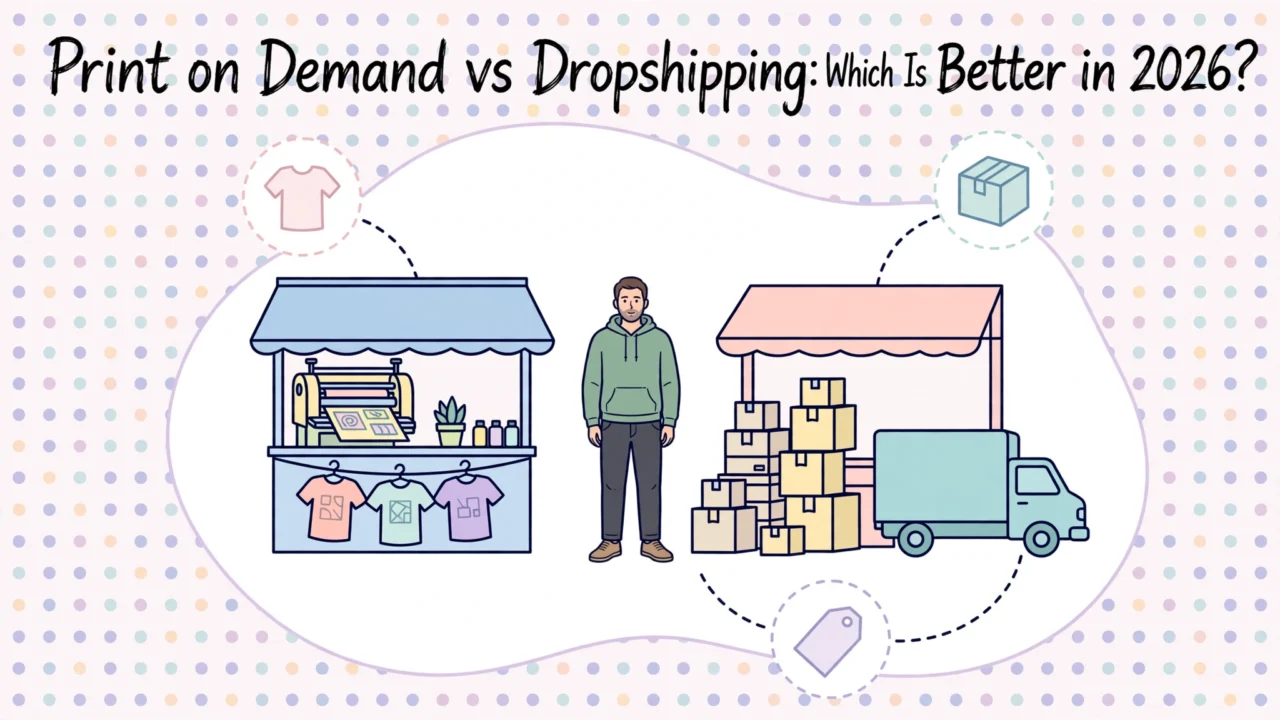

If you are weighing up print on demand vs dropshipping for your first online store in 2026, here is what most comparisons skip: both models let you sell without holding stock, but they hand you completely different jobs. One makes you a designer with a brand. The other makes you a marketer with a supplier problem to manage.
In this article
- The short answer
- How we compared them
- What print on demand actually is
- What dropshipping actually is
- Print on demand vs dropshipping at a glance
- Startup costs: print on demand vs dropshipping in real numbers
- Margins: what you actually keep
- Shipping, returns, and the customer experience
- The catch on each side
- A note on ownership, stock, and your values
- So which one should you pick?
- Frequently asked questions
- Article updates
The short answer
Here is the print on demand vs dropshipping verdict in one paragraph. Choose print on demand if you can create or commission designs and want a brand that is actually yours. Choose dropshipping if your strength is marketing, you want to test existing products quickly, and you accept supplier management and thin margins as the price of speed.
Costs are closer than the hype suggests: both can start on free plans plus a store subscription. On control, print on demand wins clearly — the product carries your design and your name. The detail below is where the print on demand vs dropshipping decision is actually made: fulfillment times, return rules, and who handles an angry customer.
How we compared them
Every price, fee, fulfillment time, and policy below was checked on November 4, 2026 against official pricing and policy pages — Printful, Printify, Shopify, Etsy — each linked next to the claim it supports. This is desk research from official sources, presented as such: no test stores were run, and company claims are labelled.
The verdicts use five criteria: startup cost 25%, profit margin 25%, control over quality and brand 20%, time to first sale 15%, scalability 15%. Cash and margin come first in any print on demand vs dropshipping comparison because they decide a beginner’s first year; control next, speed and scale last. The scorecard below uses the same weights.
What print on demand actually is
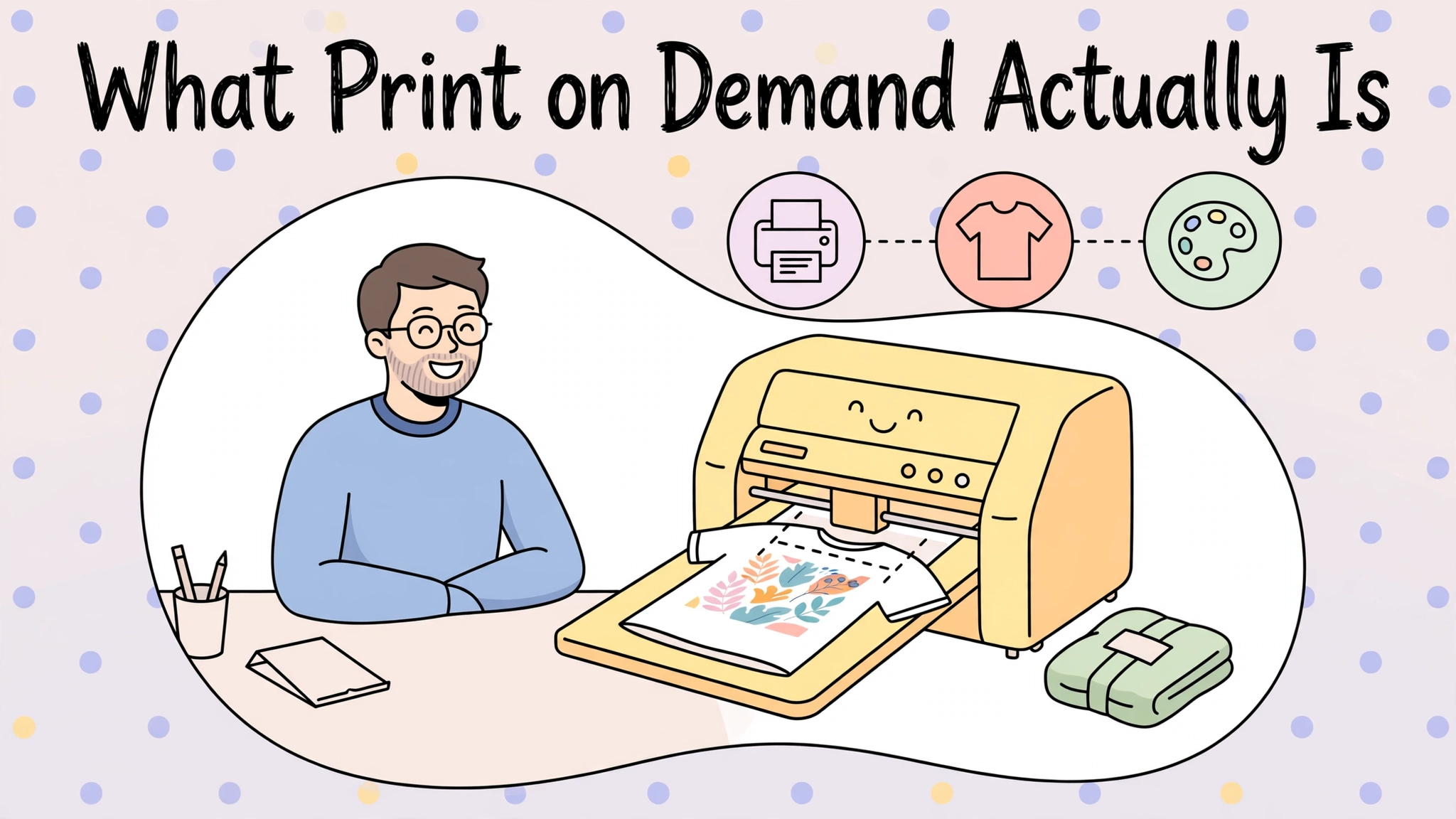
Print on demand (POD) means nothing is printed until a customer has paid. You upload a design, place it on t-shirts, mugs, notebooks, or phone cases, and list them in your store. When an order comes in, a print partner produces that single item and ships it to the buyer. No stock, and no boxes of unsold shirts if a design flops.
Beginners meet two services first: Printful, which produces in its own facilities, and Printify, which routes orders through independent print providers — its pricing page lists 70+ providers and 2,000+ products. A provider network means quality varies by provider, so ordering samples is not optional. Our full print on demand guide covers setup, niches, and the first-ten-designs workflow.
Disclosure: Some links in our articles are affiliate links, and we may earn a commission if you buy through them, at no extra cost to you. No company pays for placement here; prices come from the companies’ own pages, and verdicts are our editorial opinion.
The honest shape of POD work: your job is designs, listings, and traffic. Design for one specific audience — nurses, fishing dads, beekeepers — and you can build something durable. Slowly, though.
What dropshipping actually is
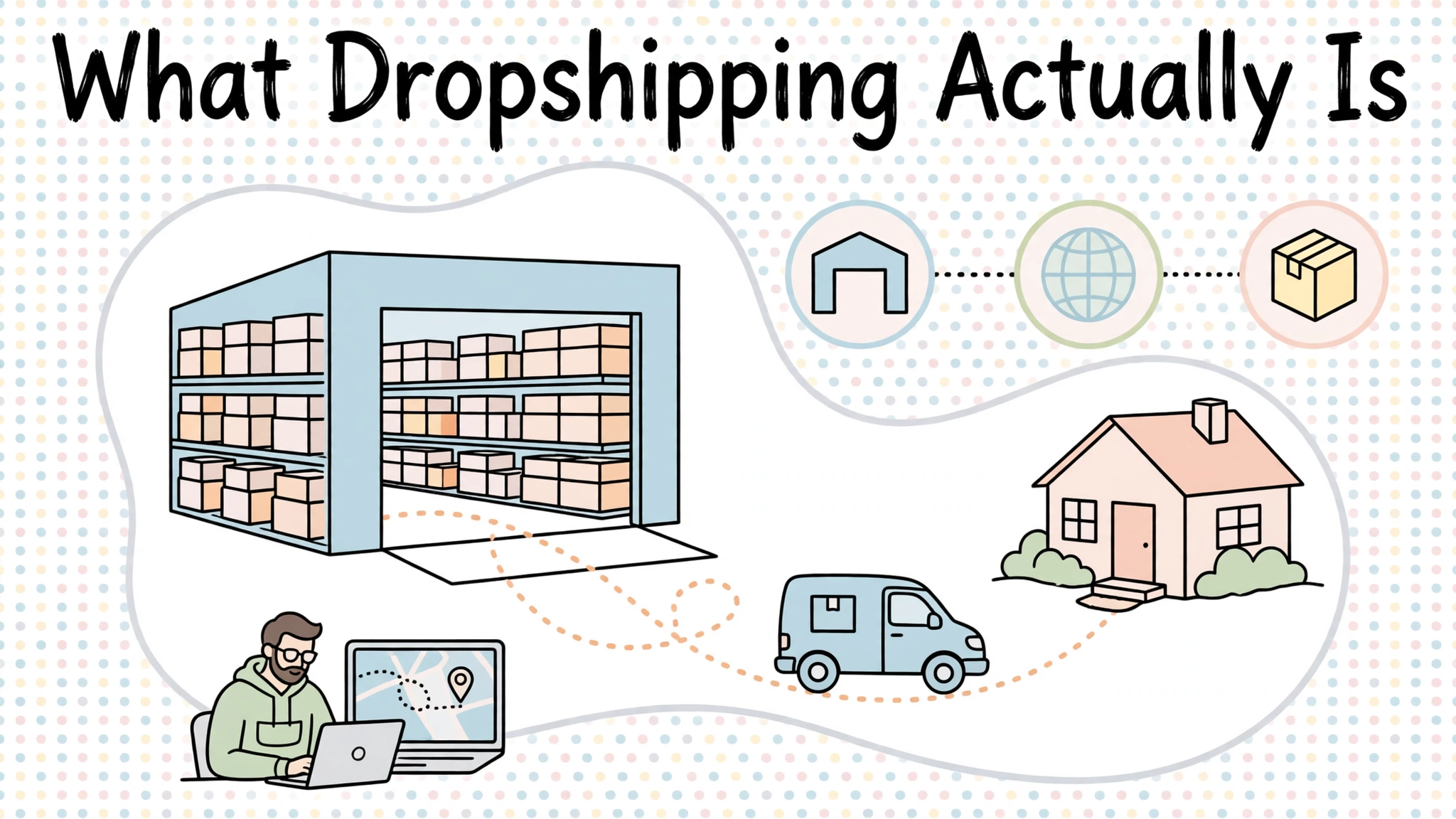
Dropshipping sells products that already exist. Shopify’s own guide defines it as a fulfillment method where the store sells without buying inventory: you forward each order to a supplier, who ships directly to your customer. You set the price and keep the gap.
One part of that guide deserves underlining: you are the seller of record. Your name is on the store, you collect payment and taxes, and you handle support, returns, and refunds — even though you never saw the product. Shopify also warns that some suppliers add their own branding to packages. Automation — DSers, described on the Shopify App Store as the official Alibaba group partner, forwards orders to AliExpress suppliers — does not protect your reputation when a parcel arrives late or flimsy.
Print on demand vs dropshipping at a glance
Here is the print on demand vs dropshipping comparison in one table.
| Factor | Print on demand | Dropshipping |
|---|---|---|
| What you sell | Your designs on blank products | Existing supplier products |
| Fulfillment | Produced after each order, shipped by the print partner | Supplier ships stocked items on your order |
| Startup cost | Can be $0 on free plans or marketplaces | Store subscription, samples, usually ad spend |
| Profit margin | You set the price; high base costs keep margins thin | Can be wider; ads and refunds eat it fast |
| Control & branding | Strong — your design, your store | Weak — many stores sell the same product |
| Shipping speed | Production time plus transit | Fast with local suppliers, slow with overseas ones |
| Returns | Defects covered by print partner; remorse returns are your cost | You are seller of record; recovery depends on supplier |
| Day-to-day work | Designing, listing, building traffic | Product research, marketing, support |
On our weights (editorial opinion, not measurements):
| Criterion | Print on demand | Dropshipping |
|---|---|---|
| Startup cost (25%) | 5 / 5 | 4 / 5 |
| Profit margin (25%) | 3 / 5 | 3 / 5 |
| Control over quality & brand (20%) | 4 / 5 | 2 / 5 |
| Time to first sale (15%) | 3 / 5 | 4 / 5 |
| Scalability (15%) | 4 / 5 | 4 / 5 |
| Weighted total | 3.9 / 5 | 3.4 / 5 |
Startup costs: print on demand vs dropshipping in real numbers
Here is the print on demand vs dropshipping startup picture. All prices are as of November 2026 — check the official page for current rates.
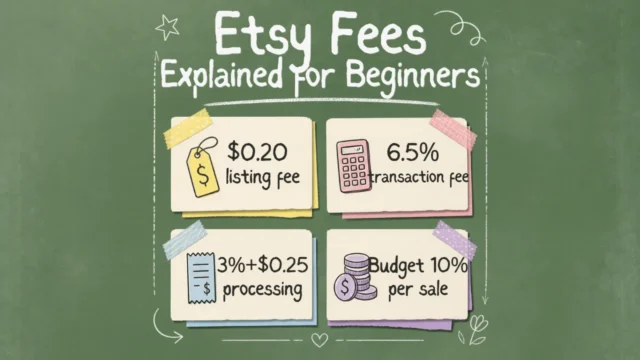
The store. With your own store, Shopify’s pricing page lists Basic at $39/month billed monthly or $29/month billed yearly (USD), with standard online card rates of 2.9% + 30¢. A marketplace route can dodge that subscription: Etsy’s Fees & Payments Policy charges a $0.20 listing fee per item (listings expire after four months), a 6.5% transaction fee on the price plus shipping and gift wrap, and some new sellers may pay a one-time set-up fee shown during onboarding.
Print on demand costs. Printful’s pricing page states it is free to sell — no upfront costs or monthly fee on the free plan; you pay for fulfillment only when a customer orders. Its optional Growth plan ($24.99/month, free at $12K/year in sales) gives up to 33% off product pricing, the company states. Printify’s pricing page shows a Free plan at $0/month for up to 5 stores, and Premium from $39/month or from $24.99/month billed yearly, with up to 20% off all products and up to 33% off new products. The real POD startup spend is samples — Printful offers 20% off sample orders on its free plan — so order your best designs first.
Dropshipping costs. Supplier apps add their own subscriptions on top — DSers publishes its plan tiers on its pricing page. Then come the two costs beginners underbudget for: samples, and traffic. With no audience, you buy visitors through ads — and ad testing can burn more cash before the first sale than everything else on this page. That hidden meter is the biggest practical difference in the print on demand vs dropshipping startup comparison.
Margins: what you actually keep
Printful states its model plainly on its pricing page: profit is the retail price minus Printful’s cost; the base price covers the blank, one print placement, and fulfillment, with shipping separate. That base cost is the whole POD game — higher than a bulk wholesale price, because you are paying for one-off production.
Discounts move the math at volume. Printify’s worked example on its Free vs Premium guide: a $12 base-cost t-shirt drops to about $9.60 at Premium’s up-to-20% discount, and the company calculates the $39/month plan breaking even at roughly 17 orders a month. The company states this, but the arithmetic is how to judge any paid plan in either model. On the dropshipping side, Shopify states that partners on Shopify Collective often offer 20–50% profit margins — the company’s figure, before your ad spend. With marketplace suppliers, margin is fragile: a price rise or a refund you absorb lands directly on it. Many sellers add a second stream on top — recommending tools they use, as our affiliate marketing beginner’s guide explains.
Our editorial take on print on demand vs dropshipping margins: neither is structurally better. POD margins are predictable but capped. Dropshipping margins can be higher per unit — and go negative in one bad week of ad spend. Predictability is worth money to a beginner.
Shipping, returns, and the customer experience
Customers care about two things: when the parcel arrives, and what happens if it is wrong.
Speed. POD has a built-in wait: the item is produced first. Printful’s shipping page puts fulfillment at 2–5 business days on average, US domestic standard shipping at 3–4 business days after that, and international standard at 5–20 — estimates, the page stresses, not guarantees. Printify’s help center says most orders ship within 2–7 business days depending on the provider, and its fulfillment guide adds 2–5 business days of US transit after dispatch. Dropshipping skips production, so a local supplier can beat POD: Shopify’s guide lists DropCommerce suppliers at two-to-seven-day shipping within North America. But an overseas supplier can be slower than any print partner: Shopify notes that ePacket orders from Chinese suppliers take between 7 and 15 business days. In print on demand vs dropshipping, shipping is not really a model question. It is a supplier-location question.
Returns. POD defect rules are at least clear. Printful states on its pricing page that manufacturing errors get a free reprint or refund; its store-policies guide adds that damage claims should be reported within 30 days of delivery, and that buyer’s remorse is not refunded — offer changed-my-mind returns and the cost is yours. Dropshipping returns are murkier: recovery depends on supplier terms that vary enormously. Budget for some returns simply being a loss.
The catch on each side
The print on demand catch
You compete on design in a market with near-zero entry barriers. Base costs squeeze from the other side: price for a real margin and you may sit above what buyers expect; price to compete and profit per order shrinks to pocket change after fees. And POD validates slowly: a design needs traffic before it produces data. Sellers who build an audience alongside the store — the content and blogging route — tend to outlast sellers who only upload.
The dropshipping catch
You control almost nothing that decides whether the customer is happy — not quality, packaging, or dispatch — yet every complaint arrives in your inbox, under your store’s name. And the product is rarely yours: if it sells, fifty other stores can list the same item next week and compete your margin down. Add dependence on paid traffic, and the model rewards people genuinely good at marketing and service, and punishes anyone who believed “passive” was part of the deal. Neither model is passive, whatever the ads promise — our breakdown of realistic passive income models shows where both sit.
A note on ownership, stock, and your values
Some Muslim readers prefer not to sell items they do not yet own or hold stock of. The two models differ on exactly that point: In print on demand, the item is produced after your customer orders it, under your agreement with the print partner. In classic dropshipping, you sell an item held in a supplier’s stock, shipped onward after your sale. Setups vary, so examine the exact model and supplier terms you are considering, and consult a scholar you trust. We are not scholars, and this is not a religious ruling. Either way, honest descriptions and fair refund handling are part of selling with integrity, whichever side of print on demand vs dropshipping you land on.
So which one should you pick?
The print on demand vs dropshipping decision comes down to which daily work you would rather do — results vary depending on niche, effort, and timing in both, and you will be doing the work for months before either pays properly.
- Creative or design-minded? Pick print on demand. Start on a marketplace or a free plan, order samples, and build a catalog. Our Etsy selling guide covers the marketplace route step by step.
- A marketer first? Pick dropshipping. The model’s speed is a real asset — pick suppliers near your customers, and order everything yourself first.
- Building a long-term brand? Pick print on demand. A design catalog under your name is an asset; a store built on a supplier’s catalog is hard to defend.
- Want to validate demand first? Dropshipping can test demand; then design POD versions of winners.
- Need income this month? Pick neither, yet. Both models pay late at the start; starting freelancing usually pays faster and can fund your store.
Our default recommendation for a complete beginner weighing print on demand vs dropshipping: print on demand, a narrow niche, marketplace first, samples ordered, ten designs live before you judge anything. It is the slower road — and the one where what you build stays yours.
Frequently asked questions
Which is cheaper to start — and more profitable?
Print on demand is usually cheaper to start — $0 on free plans and marketplaces, while dropshipping typically needs a store subscription, samples, and often an ad budget. On profit, neither model wins automatically: POD margins are thinner but predictable, while dropshipping margins can be wider per unit but are exposed to ad costs, supplier price changes, and refunds you absorb. Cheaper to start is not cheaper to run, either — base costs and traffic costs decide the real print on demand vs dropshipping economics, and profit in both comes from a niche with real demand and pricing done with a calculator, not hope.
How long until my first sale?
Timelines vary widely. A dropshipping store with ad spend can sometimes sell within days; a POD store on a marketplace may take weeks or months of uploading before the first order. Sellers who reach a first sale usually launched with several products live, not one.
Do I need my own website?
No. Marketplaces provide the storefront — Etsy is the common POD route, with the fees covered above. Your own store adds control over branding and customer data, but you bring all your own traffic.
Article updates
November 4, 2026: First published. All pricing, fulfillment-time, and policy facts checked against official Printful, Printify, Shopify, DSers, and Etsy pages on this date. Comparison criteria and weighted scores are editorial. Facts re-check scheduled within 60 days.



[…] Digital Business […]
[…] you are still deciding between the two models, our print on demand vs dropshipping comparison walks through the costs, margins and control side by […]