
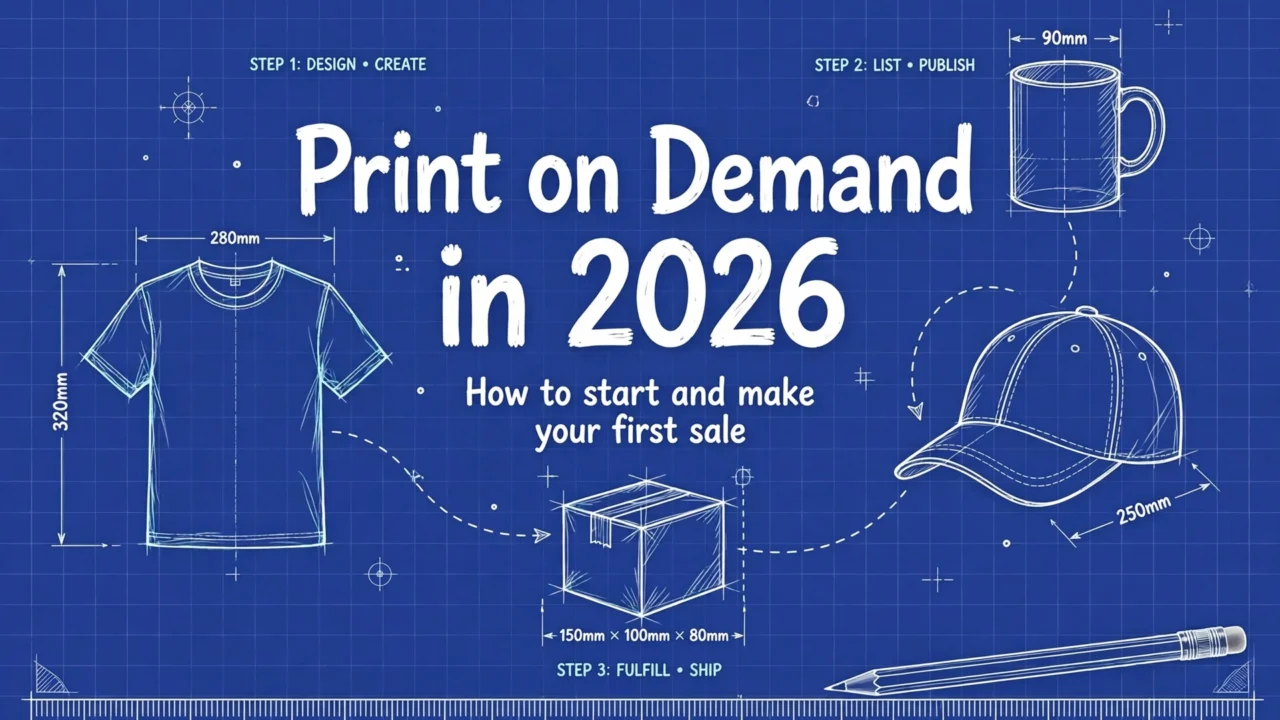

Print on demand 2026 is still one of the lowest-risk ways to start selling online. You don’t buy inventory, you don’t pack boxes, and you don’t ship anything yourself. You create a design, put it on a product, and a print on demand 2026 printing partner handles the rest — only printing an item after a customer has already paid for it. This guide walks you through the whole thing: how print on demand actually works, which platform to pick, how to make designs that sell, and the mistakes that kill most beginner stores.
In this article
- Print on Demand 2026 in One Minute
- How Print on Demand Actually Works
- Why 2026 Is Still a Good Time to Start
- Picking a Niche That Sells
- The Platforms Compared: Printful vs Printify vs Redbubble vs TeePublic vs Etsy
- Your First 10 Designs: A Practical Workflow
- Pricing, Profit Margins, and Realistic Earnings
- Getting Traffic Without Paid Ads
- Mistakes That Kill New POD Stores
- Print on Demand 2026: Frequently Asked Questions
- The Bottom Line on Print on Demand in 2026
- Article updates
If you are still deciding between the two models, our honest comparison of print on demand vs dropshipping walks through the costs, margins and control side by side.
Print on Demand 2026 in One Minute
If you’re short on time, here’s the whole model: you upload a design to a print on demand platform, choose products like t-shirts, hoodies, or mugs, and set your price. When someone buys, the platform prints your design on the product and ships it to the customer. You keep the difference between the sale price and the base cost. Your job is three things — pick a niche, make good designs, and get traffic. Everything else is handled for you.
How Print on Demand Actually Works
Traditional e-commerce works like this: you buy 500 shirts upfront, store them somewhere, and hope they sell. Print on demand 2026 flips that around. Nothing exists until someone orders it — that’s the core advantage of print on demand 2026.
The flow has four steps:
- You create a design — a graphic, a funny quote, or a niche illustration made in a tool like Canva.
- You list it on products — upload the design to a platform, place it on a t-shirt, hoodie, mug, or poster, and set your selling price.
- A customer orders — they pay you the full retail price through the platform.
- The printer fulfills it — the print partner prints, packs, and ships the item directly to the buyer. You never touch it.
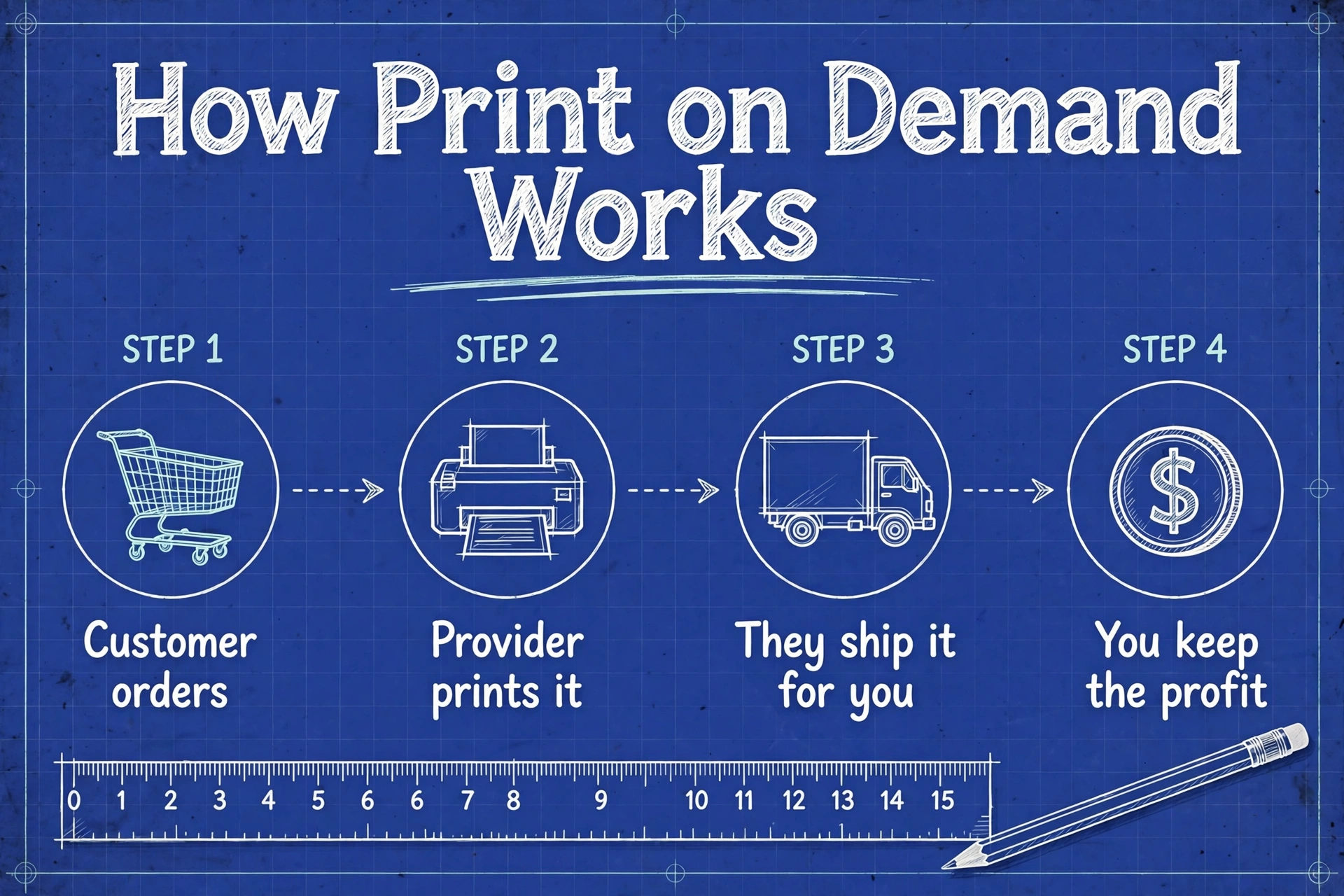
Your profit with print on demand 2026 is the gap between what the customer paid and what the printer charged you. Sell a shirt for $25 that costs $12 to print and ship, and you keep $13 — minus any platform fees. No warehouse, no unsold stock, no upfront investment beyond your time.
Why 2026 Is Still a Good Time to Start
People have been declaring print on demand “dead” or “saturated” for years. Here’s why print on demand 2026 is still worth your time:
- Zero inventory risk. The worst case isn’t a garage full of unsold shirts — it’s a design nobody buys, which cost you an afternoon.
- AI design tools lowered the bar. You don’t need to be an illustrator anymore. Tools for generating and cleaning up artwork mean a beginner can produce professional-looking designs in 2026.
- The Q4 surge is real. Searches for custom gifts climb every autumn, and the Christmas shopping season is the biggest sales window of the year for print on demand sellers. Getting your store and designs indexed before the holidays is one of the highest-leverage things a new seller can do.
- Global selling from anywhere. If you’re freelancing from Pakistan or a similar market, marketplaces like Redbubble pay artists via PayPal (bank transfer in the US, UK, and Australia only), with a $10/€10/£10 payout threshold — the same rails covered in our freelancing roadmap. No US bank account required.
Saturated? The generic “funny cat shirt” space, yes. Specific niches with real buyers? Still wide open — which brings us to the most important decision you’ll make.
Picking a Niche That Sells
The difference between stores that make sales and stores that don’t is almost always the niche. Generic designs compete with millions of others. Specific designs find buyers who feel like the product was made for them.
A practical formula that works for print on demand 2026: niche + occasion + year. Instead of “funny dog shirt,” try “funny beagle mom birthday 2026.” Instead of “gym motivation,” try “powerlifting grandpa.” The more specific, the less competition — and the more the buyer feels seen.
Good niche hunting grounds:
- Professions with pride: nurses, truckers, teachers, electricians — people buy shirts that say who they are.
- Hobbies with identity: fishing, gaming, gardening, baking — hobbies people build personalities around.
- Family roles + occasions: “best dad ever” gifts still sell every Father’s Day, birthday, and Christmas.
- Pets by breed: a dachshund owner will not buy a generic dog shirt. They’ll buy the dachshund one.
Validate before you commit: search your niche phrase on the marketplace you plan to use. If results exist but look low-effort, that’s your opening. If a phrase has zero results, check whether anyone actually searches for it — Google Trends is free and takes thirty seconds.
Disclosure: Some links in this article may earn Dear Thoughts a commission if you buy through them, at no extra cost to you. No company pays for placement — our rankings and verdicts are editorial.
The Platforms Compared: Printful vs Printify vs Redbubble vs TeePublic vs Etsy
There are two kinds of print on demand platforms in 2026: fulfillment services (they print; you bring the store and traffic) and marketplaces (they bring built-in traffic; you just upload).
Printful — the quality leader. Excellent print quality and reliable shipping, but higher base costs, which squeezes your margin. Best if you’re building your own brand store and quality is the selling point.
Printify — a network of print providers competing on price. Lower base costs mean fatter margins, but quality varies by provider, so order samples first. Best for sellers who want maximum profit per sale and don’t mind managing provider choice.
Redbubble — a marketplace with built-in traffic. Upload designs, Redbubble handles everything including the customers. Margins are fixed and modest (you set a markup percentage), but there’s zero setup and millions of monthly visitors. A great first platform.
TeePublic — similar marketplace model to Redbubble, strong in apparel and artist-friendly. Same trade-off: easy start, thinner margins.
Etsy + a POD partner — you open your own Etsy shop and connect Printful or Printify to fulfill orders. More work (you handle the shop, SEO, and customer messages), but higher margins and a real brand you own. Our full guide to selling on Etsy in 2026 walks through setup, fees, and getting your first 100 sales — this combo is one of the highest-ceiling paths in print on demand right now.
Beginner recommendation for print on demand 2026: start on Redbubble or TeePublic to learn what sells with zero risk, then graduate your winners to an Etsy shop fulfilled by Printify for bigger margins.
Your First 10 Designs: A Practical Workflow
You don’t need ten masterpieces. You need ten solid, niche-specific designs to learn what the market wants. Here’s a workflow that works in 2026:
- Step 1 — Pick one niche. All ten designs serve the same audience (e.g., fishing dads). A focused shop converts better than a random one.
- Step 2 — Research phrases. Write down 10 phrases your niche actually says — jokes, pride statements, occasion lines. Check each on Google Trends.
- Step 3 — Design in Canva. Use bold, readable typography and simple graphics. Designs must read clearly at thumbnail size — most buyers decide from a tiny image.
- Step 4 — Mock up properly. Never upload a flat design file as your main image. Show it on a realistic shirt mockup. Good mockups outsell good designs with bad mockups.
- Step 5 — Write real titles and tags. “Funny Fishing Dad Shirt, Gift for Fisherman, 2026 Birthday Gift” beats “Cool Shirt Design 1.” Every word is a search term.
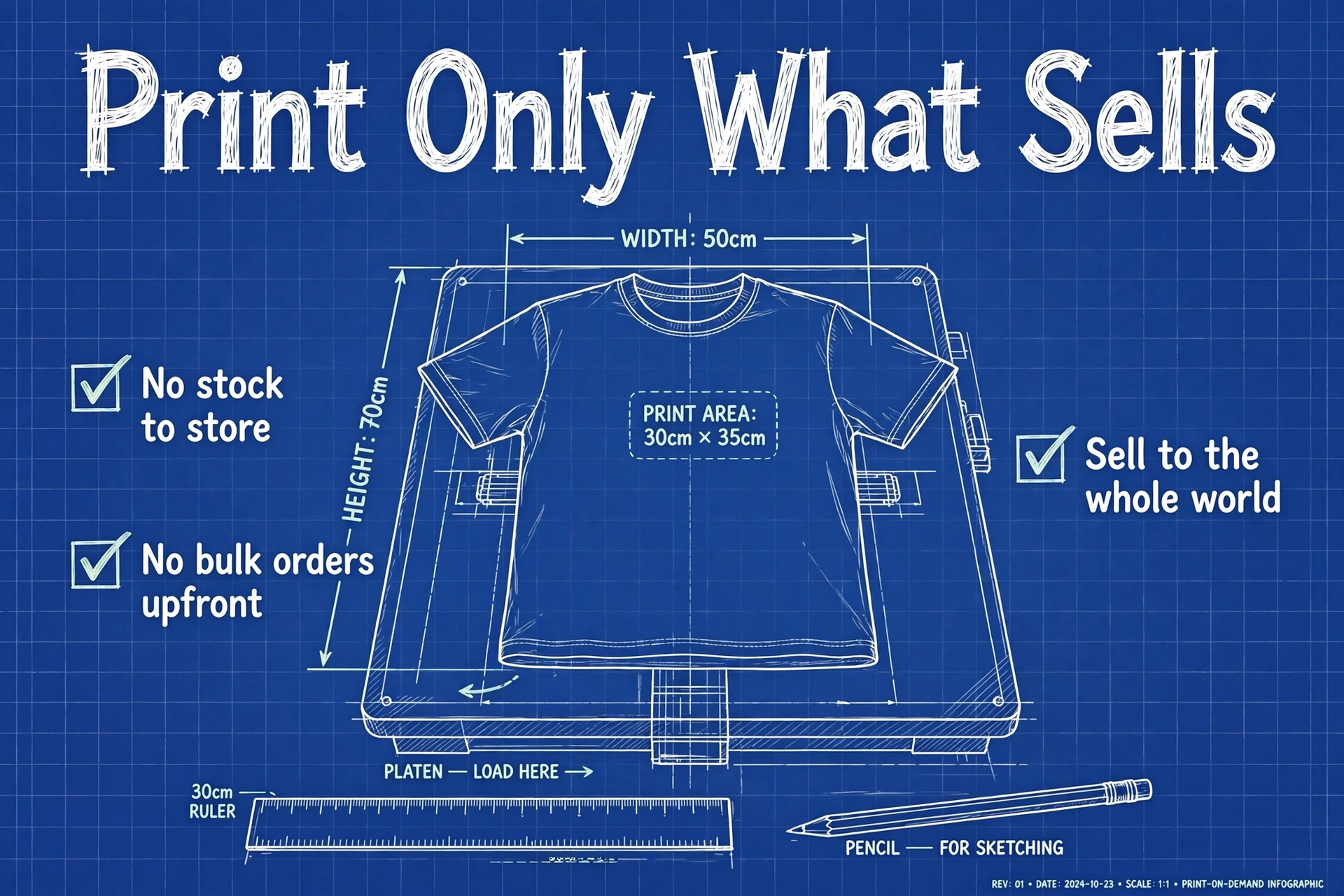
Expect most of your first ten to flop. That’s normal and valuable — the data tells you which direction to double down on. Print on demand 2026 rewards sellers who treat the first month as research, not as a lottery ticket.
Pricing, Profit Margins, and Realistic Earnings
Pricing is simple math: base cost + your margin = retail price, and the retail price has to match what buyers expect to pay.
Typical numbers for print on demand 2026: a standard t-shirt costs $11–$14 to print and ship via Printify, and sells for $22–$28. That leaves $8–$15 profit per shirt before platform fees. Hoodies cost more ($25–$35 base, as of October 2026 — check the official page for current rates) but sell for $45–$55, with similar dollar margins. Marketplace platforms like Redbubble fix your margin as a percentage — 10% of the base price by default unless you raise it.
Realistic earnings for a beginner: your first month might bring $0–$50 while you learn. Sellers with 50–100 solid niche designs and steady uploading can sometimes reach $200–$500/month within 3–6 months — but results vary widely depending on niche, effort, and timing. Four figures a month is achievable but usually takes a year of consistent work and a few winning designs doing the heavy lifting. Anyone promising faster results from print on demand 2026 is selling you a course, not a strategy.
One more income stack worth knowing: many POD sellers also earn from affiliate marketing by recommending the tools they use — design software, mockup generators, courses. Same audience, second income stream, zero extra products.
Getting Traffic Without Paid Ads
On marketplaces like Redbubble, the platform brings some traffic — but your own promotion multiplies it. On Etsy or your own store, traffic is entirely your job. The good news: the free channels work well for print on demand 2026.
- Pinterest. One of the highest-ROI free channels for POD. Product pins with good titles act like a visual search engine and keep sending clicks for months. Post every design as a pin.
- TikTok and Reels. Short videos of the design process, packing orders, or “which design should I make next?” polls build an audience that buys on launch.
- SEO content. A simple blog reviewing gift ideas for your niche (“15 funny fishing gifts for dad”) can rank on Google and funnel buyers to your products for years. Our guide to starting a blog in 2026 covers the exact setup.
- Etsy search. If you sell on Etsy, the marketplace’s own search is your main traffic source — titles, tags, and descriptions done right (covered in our Etsy selling guide) compound with every listing you add.
Mistakes That Kill New POD Stores
- Using copyrighted characters or trademarks. This is the big one. Putting a cartoon character, sports logo, or celebrity face on a shirt will get your listings removed — and repeated violations get your whole account banned, on every platform. Make original designs only. No exceptions.
- Designing for everyone. “Funny quote shirts” is not a niche. Ten designs for ten different audiences is ten times the work with a tenth of the signal.
- Skipping mockups. A great design shown as a flat PNG file looks amateur and doesn’t sell. Always show the product.
- Quitting at design #12. Almost nobody’s first dozen designs are winners. The sellers making real money in print on demand 2026 are the ones who uploaded design #100.
- Ignoring the numbers. If a design gets views but no sales, the price or mockup is wrong. If it gets no views, the title and tags are wrong. The data tells you what to fix — listen to it.
Print on Demand 2026: Frequently Asked Questions
How much does it cost to start print on demand 2026?
On marketplaces like Redbubble or TeePublic: $0. On Etsy: about $0.20 per listing plus transaction fees. With Printful or Printify on your own store: the platform subscriptions are free to start (see Printful’s pricing and Printify’s pricing); you pay per order when items sell. Realistically you can start print on demand 2026 for under $20.
Do I need a website for print on demand?
No. Marketplaces (Redbubble, TeePublic) and Etsy give you a storefront without a website. A website or blog helps with traffic later, but it’s optional at the start.
Can I do print on demand from Pakistan?
Yes. Redbubble, TeePublic, Printful, Printify, and Etsy all accept sellers from Pakistan. Marketplaces like Redbubble pay artists via PayPal (bank transfer in the US, UK, and Australia only), with a $10/€10/£10 payout threshold. Note: Etsy requires Etsy Payments, which isn’t available in every country — check Etsy’s country availability before opening a shop. Our freelancing guide explains the payout setup that POD sellers use too.
How long until my first sale?
On marketplaces, anywhere from a few days to a few months depending on niche and design count. On Etsy with good SEO, some sellers report their first sale within 2–4 weeks of consistent listing — but timelines vary widely. Volume and niche specificity are the two levers.
Is print on demand passive income?
Semi. Designs you uploaded a year ago can still sell while you sleep — that’s the passive part. But staying competitive means regularly adding new designs, which is active work. Think of it as front-loaded effort with a long tail, like the realistic models in our passive income with AI guide.
The Bottom Line on Print on Demand in 2026
Print on demand 2026 remains one of the fairest deals in online business: no inventory, tiny startup costs, and global reach from day one. The catch — and it’s the whole game — is that your designs must serve a specific audience better than the generic competition does. Pick a niche, upload your first ten designs this week, learn from the data, and keep going. And when you’re ready to own your margins instead of renting them from a marketplace, pair your POD operation with your own shop — our Etsy selling guide for 2026 is the natural next read.
Article updates
- October 13, 2026 — Credibility review: added official sources for pricing, fees, and platform policies; softened absolute claims.



[…] and ship. It’s the hands-off combo: Etsy’s traffic plus POD’s zero inventory. Our print on demand guide for 2026 covers the full workflow, and section 7 below shows exactly how to pair it with […]
[…] Set expectations first: blogs earn on a delay. Many bloggers report seeing their first meaningful income between months six and twelve — but timelines vary widely depending on niche, effort, and timing. The main paths, in order of beginner-friendliness: display ads pay per visitor and need volume — entry-level networks like Journey by Mediavine accept sites from around 1,000 monthly sessions (as of October 2026 — check the official requirements page, since thresholds change), while premium ad management wants far more traffic. Affiliate marketing pays far better per visitor: recommend tools you genuinely use and earn commissions on resulting sales, a model our beginner’s guide to affiliate marketing in 2026 breaks down step by step. Digital products — templates, ebooks, presets — keep most of each sale after payment processing fees (Stripe charges 2.9% + 30¢ per transaction, for example) and suit how-to niches perfectly.If you’d rather sell physical products without holding inventory, see our guide to starting pr… […]
[…] free Image Creator is personal-use only. If you plan to sell designs on merchandise, read our print-on-demand guide and each platform’s AI-content policy first — some marketplaces restrict AI-generated […]
[…] or products you sell. The most common way readers monetise these tools is print on demand — our print on demand guide shows the full […]
[…] A provider network means quality varies by provider, so ordering samples is not optional. Our full print on demand guide covers setup, niches, and the first-ten-designs […]