

Freelancing is no longer the backup plan — for tens of millions of people, it is the plan. Roughly 39% of the US workforce did some freelance work in 2026, and the global freelance platforms market keeps growing year after year. But the game changed: clients now expect you to work with AI, specialists tend to earn more than generalists, and the old “sign up on a marketplace and wait” playbook rarely works on its own.
In this article
- Step 1: Pick One Service, Not Five
- Step 2: Build Proof Before You Have Clients
- Step 3: Choose Your Platforms Wisely
- Step 4: Price for Value, Not Hours
- Step 5: Land the First Client
- Step 6: Use AI as Leverage, Not a Crutch
- Mistakes That Kill Beginner Freelance Careers
- Freelancing Online in 2026: Frequently Asked Questions
- Article updates
This is a practical roadmap for starting from zero in 2026 — no fluff, no rented-lamborghini promises. Just the steps that actually lead to a first paying client.
Step 1: Pick One Service, Not Five
The most common beginner mistake is listing every skill on a profile: writing, design, video editing, data entry, translation. In 2026, “I do everything” usually loses to “I do this one thing well.” Clients search for specialists and often pay specialists more.
Good starter services pair an existing ability of yours with 2026 demand:
- AI-assisted content writing — blog posts, newsletters, product descriptions (you bring judgment and voice; AI brings speed).
- Short-form video editing — reels and TikToks for businesses; demand has grown sharply with AI video tools.
- AI workflow setup — helping small businesses automate repetitive work with chatbots and no-code tools.
- Design with Canva/Figma — social media kits, pitch decks, brand assets for startups.
- Virtual assistance — inbox, calendar, and operations support, increasingly AI-augmented.
Skills that explicitly reference AI grew 109% year-over-year on the Upwork marketplace — but you do not need to be an “AI expert.” You need to be a competent professional who uses AI tools fluently to deliver faster, better work.
Step 2: Build Proof Before You Have Clients
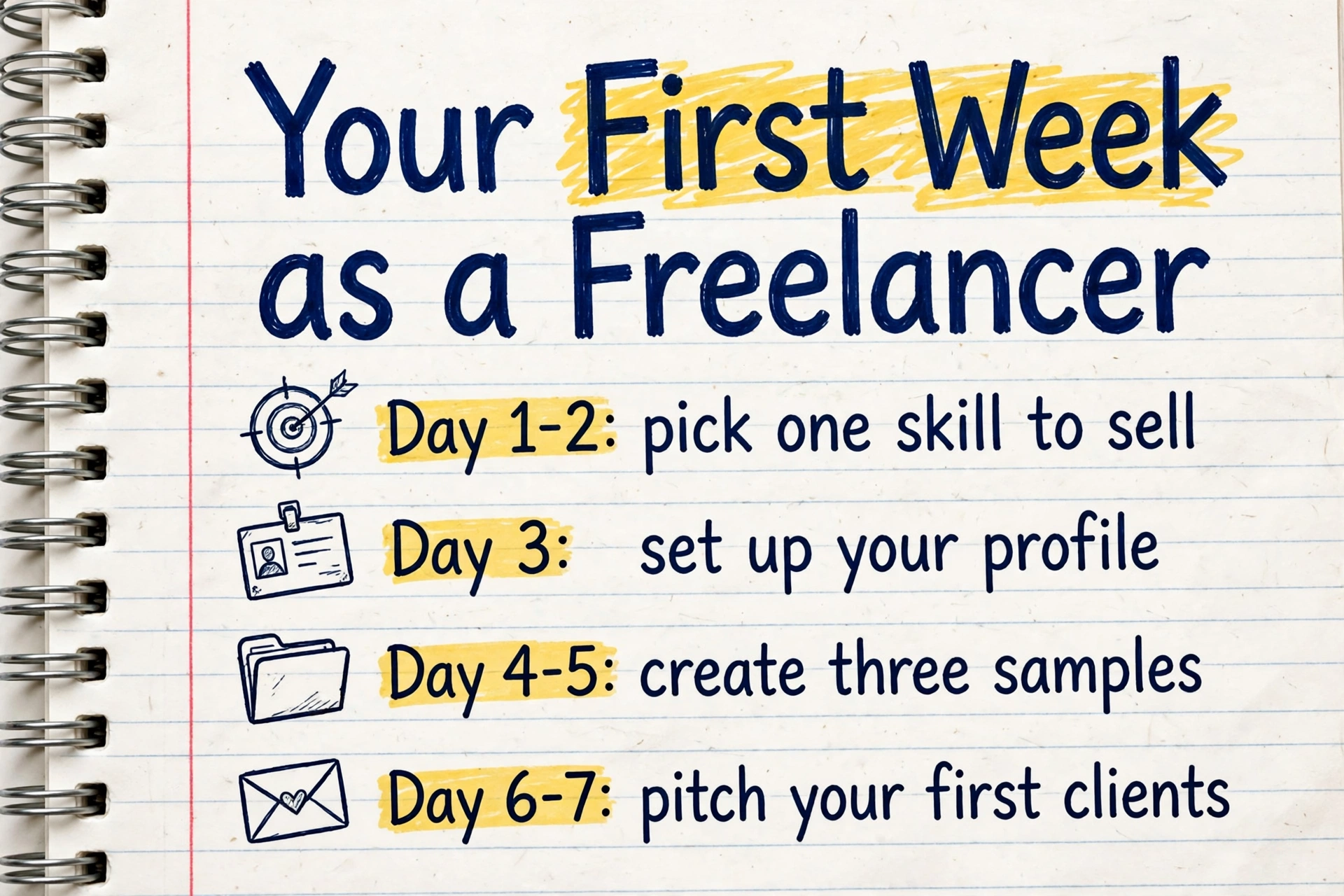
Clients do not hire potential; they hire proof. Before your first pitch, create 3–5 portfolio samples that look like real client work:
- Pick imaginary but realistic clients (a skincare brand, a local restaurant, a SaaS startup).
- Produce the deliverable exactly as you would for a paying client.
- Present each sample with context: the problem, what you made, and the result it would drive.
Host them somewhere free and professional — a simple portfolio site, a Notion page, or even a well-organized Google Drive folder. In 2026, clients want proof of impact, so frame samples around outcomes (“a landing page structured to convert visitors into trial signups”) rather than just deliverables (“I made a landing page”).
Disclosure: Some links in this article may earn Dear Thoughts a commission if you buy through them, at no extra cost to you. No company pays for placement — our rankings and verdicts are editorial.
Step 3: Choose Your Platforms Wisely
Not all platforms cost you the same. Fee structures in 2026 vary dramatically:
- Upwork — the largest marketplace; fees now run on a variable 0–15% model depending on supply and demand in your category. Best for project-based and long-term contract work.
- Fiverr — productized gigs with a flat 20% commission. Best if you can package your service as a clear, fixed-price offer.
- Contra — a zero-commission platform gaining ground as freelancers push back on high take rates. Smaller client pool, but you keep everything you earn.
- Direct outreach — emailing or messaging businesses yourself. Zero fees, highest effort, often the best clients.
A smart beginner setup: one main marketplace where you invest proposal energy, plus direct outreach on the side. Do not spread yourself across six platforms — depth beats breadth when you have no reviews yet.
A note on getting paid internationally: if you are freelancing from Pakistan or a similar market, receiving payments matters as much as earning them. Wise and Payoneer are popular options for international transfers — fast and low-fee compared with traditional wire transfers. Set up at least two payout methods before your first invoice.
Step 4: Price for Value, Not Hours
Beginners almost always undercharge. In 2026, the winning pricing shift is from hourly billing to value-based and packaged pricing:
- Productize: sell a “website SEO audit — $150, delivered in 5 days” instead of “SEO work at $15/hour.” Fixed scope, fixed price, no timesheets.
- Anchor on outcomes: a sales page is not worth 5 hours of your time; it is worth the revenue it generates. Price a fraction of that.
- Raise rates with proof: after every 3–5 successful projects, raise your prices 20–30%. Your early low rates bought you reviews; now cash them in.
- Offer retainers: recurring monthly packages (“4 blog posts + newsletter, $800/month”) beat one-off gigs for income stability — and many clients prefer them over re-hiring per project.
Step 5: Land the First Client
Your first client will almost certainly come from effort, not from a polished profile sitting idle. Work this sequence:
- Warm network first. Tell everyone you know what service you now offer. Friends, former colleagues, family businesses, local shops — your first 1–2 clients are usually one introduction away.
- Targeted outreach. Find 20 businesses with an obvious gap (no blog, outdated website, inactive socials) and send each a short, specific message: what you noticed, what you would fix, and one sample proving you can. Personalize every message — templates are invisible.
- Marketplace proposals. On Upwork or Fiverr, apply only to jobs you can genuinely nail, and lead with the client’s problem, not your life story. Two short paragraphs plus one relevant sample beats a five-paragraph essay.
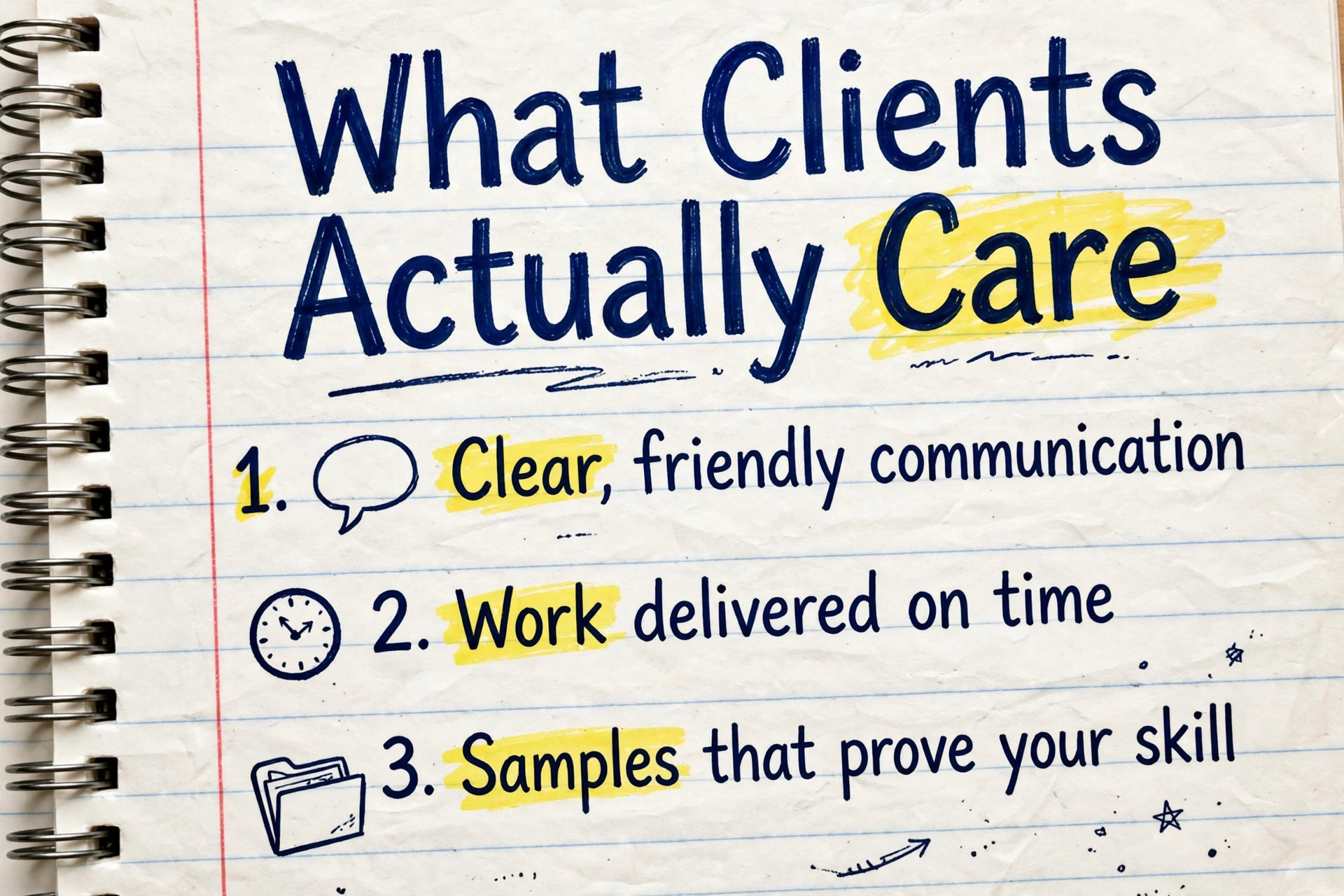
- Deliver like your career depends on it — because at this stage, it does. Over-communicate, hit the deadline early, and ask for a testimonial the moment the client is happy.
One happy client who refers you is worth ten cold pitches. Freelancing compounds: reviews bring visibility, visibility brings better clients, better clients bring higher rates.
Step 6: Use AI as Leverage, Not a Crutch
In 2026, clients assume you use AI — the advantage goes to freelancers who use it well:
- Speed up drafting with ChatGPT or Claude, then edit ruthlessly in your own voice. Clients pay for judgment, not raw output.
- Automate the boring parts — proposals, invoices, follow-ups, research summaries — with no-code tools.
- Disclose honestly. If a client asks, say plainly which parts of the workflow use AI. Trust and transparency win long-term clients; pretending otherwise loses them.
- Never ship raw AI output. Unedited AI work is detectable, generic, and increasingly a fast track to a bad review.
Think of AI as a junior assistant: fast, tireless, and in need of supervision. You are the senior partner whose name goes on the work.
Once you’re set up, these ChatGPT prompts for freelancers will speed up your proposals, client updates and invoices.
Mistakes That Kill Beginner Freelance Careers
- Competing on price alone. There is always someone cheaper. Compete on reliability, communication, and niche expertise instead.
- Scope creep without boundaries. “Just one more revision” repeated ten times turns a profitable project into a loss. Put revision limits in writing before you start.
- Ignoring the business side. Track income, set aside tax money, and get work agreements in writing — even simple ones. The EU’s platform-work rules and similar regulations worldwide are raising the bar on documentation; be ahead of it.
- Quitting at week three. Most beginners quit right before momentum starts. Give the system a few months of consistent effort before judging it.
Freelancing Online in 2026: Frequently Asked Questions
Is freelancing still viable for beginners in 2026?
Yes — but the bar is higher. Generic, low-effort services are being squeezed by AI. Beginners who specialize, show proof of work, and use AI as leverage are landing clients steadily. The opportunity moved upmarket, not away.
How much can a beginner freelancer earn?
It varies wildly by skill and market, but a realistic first-year range for a consistent beginner is a few hundred to a few thousand dollars per month. Specialists in AI-adjacent services command premium rates far above that. Anyone promising fixed income figures is selling a course, not advice.
Which freelance platform is best for beginners?
Upwork has the most clients but fierce competition; Fiverr suits packaged, fixed-price services; zero-commission platforms like Contra let you keep everything you earn. Start with one marketplace plus direct outreach rather than spreading thin.
Do I need to know AI to freelance in 2026?
You need AI literacy, not AI expertise. Clients expect you to use modern tools fluently — for research, drafting, design, or automation — the way they once expected you to use email. The premium goes to judgment and specialization, not to the tools themselves.
How do I get paid from another country?
Wise and Payoneer cover most bank-transfer needs for freelancers in Pakistan and similar markets — both offer fast, low-fee international transfers. Set up at least two payout rails before you invoice your first client.
Related reading: we compared the two biggest platforms in Fiverr vs Upwork in 2026: Which Platform Is Better for Beginners?
Article updates
- October 13, 2026 — Credibility review: added official sources for pricing, fees, and platform policies; softened absolute claims.



[…] of the biggest winners from these tools are independent professionals — see our beginner’s roadmap to starting freelancing in 2026 for how to turn AI-assisted skills into paying […]
[…] notify. You can ship a working prototype for a client in an afternoon, which is a powerful way to start freelancing with AI services without a computer science […]
[…] it suits: tinkerers who like talking to business owners. If you are starting freelancing, this is a natural high-value service to add — and our beginner’s guide to AI agents is a […]
[…] judgment, not just output — strategy, editing, custom development, and specialized design. Our beginner’s freelancing roadmap for 2026 covers which skills are actually AI-resistant this […]
[…] format you can publish. If you freelance, review the tools in your own workflow — our beginner’s freelancing roadmap pairs naturally with this, since freelancers buy software […]
[…] print on demand platforms pay out through Payoneer and Wise — the same rails covered in our freelancing roadmap. No US bank account […]
[…] earn their first dollars freelancing the skill they blog about. If writing is your lane, our freelancing roadmap and Fiverr vs Upwork comparison show exactly where beginners land their first clients. Treat the […]
[…] for you, and every output needs your eyes before it goes out. New to this? Start with our guide on how to start freelancing, and if you’re choosing where to find clients, our Fiverr vs Upwork comparison covers both […]
[…] For collaborative writing, nothing free comes close. If you plan to write for clients, our guide to starting freelancing covers finding your first […]