
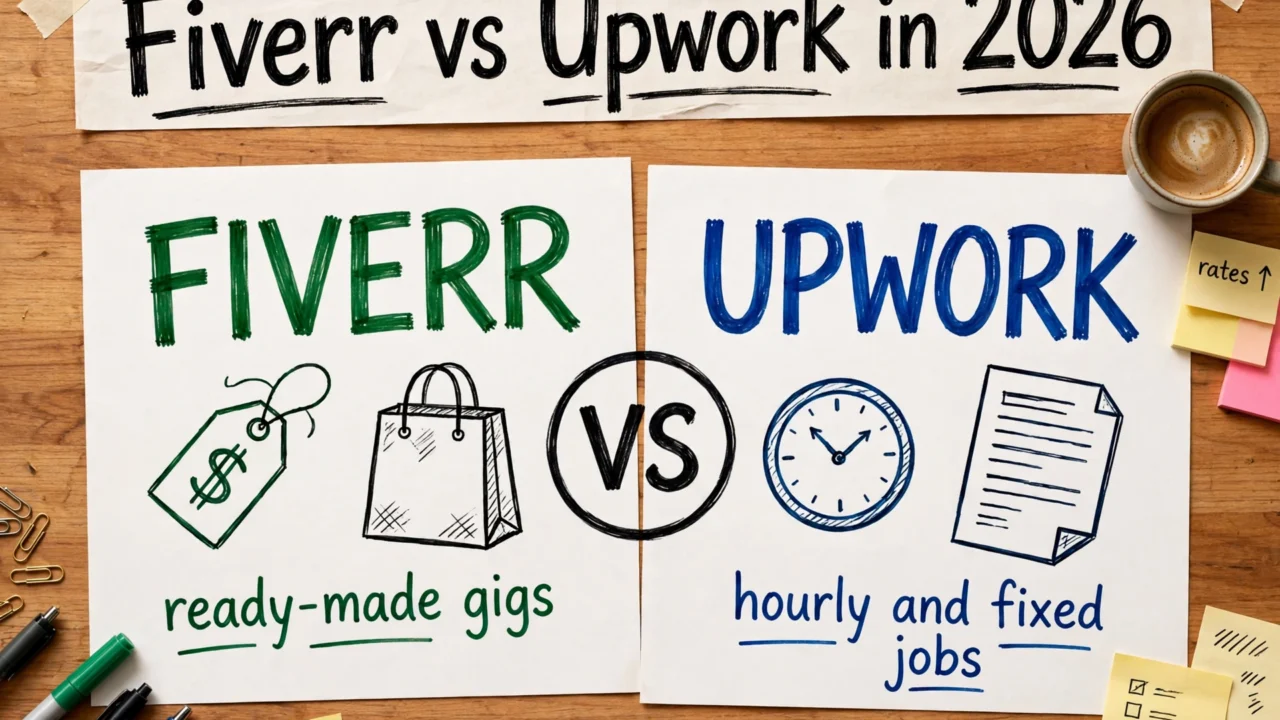

Every beginner freelancer asks the same question: Fiverr vs Upwork in 2026 — which one should I start with? They are two of the biggest freelance platforms in the world, but they work in completely opposite ways. Pick the wrong one for your situation and you can waste months bidding on jobs you will never win — or waiting for orders that never come.
In this article
- Fiverr vs Upwork 2026: how they work
- How we compared them
- Fiverr vs Upwork 2026: fees compared
- Fiverr vs Upwork 2026: getting your first client
- Fiverr vs Upwork 2026: earning potential
- Fiverr vs Upwork 2026: which fits your work style?
- Fiverr vs Upwork 2026: which skills win on each platform?
- The 2026 strategy: start on Fiverr, graduate to Upwork
- Fiverr vs Upwork 2026: mistakes beginners make
- Fiverr vs Upwork 2026: getting paid
- Fiverr vs Upwork 2026: frequently asked questions
- The bottom line on Fiverr vs Upwork 2026
- Article updates
This Fiverr vs Upwork 2026 comparison breaks down how each platform actually works this year: fees, how you get clients, what beginners really earn, and which one fits your skills. The honest answer to the Fiverr vs Upwork 2026 debate is that many successful freelancers eventually use both — but where you start matters enormously.
Fiverr vs Upwork 2026: how they work
The core difference in this comparison is the direction work flows:
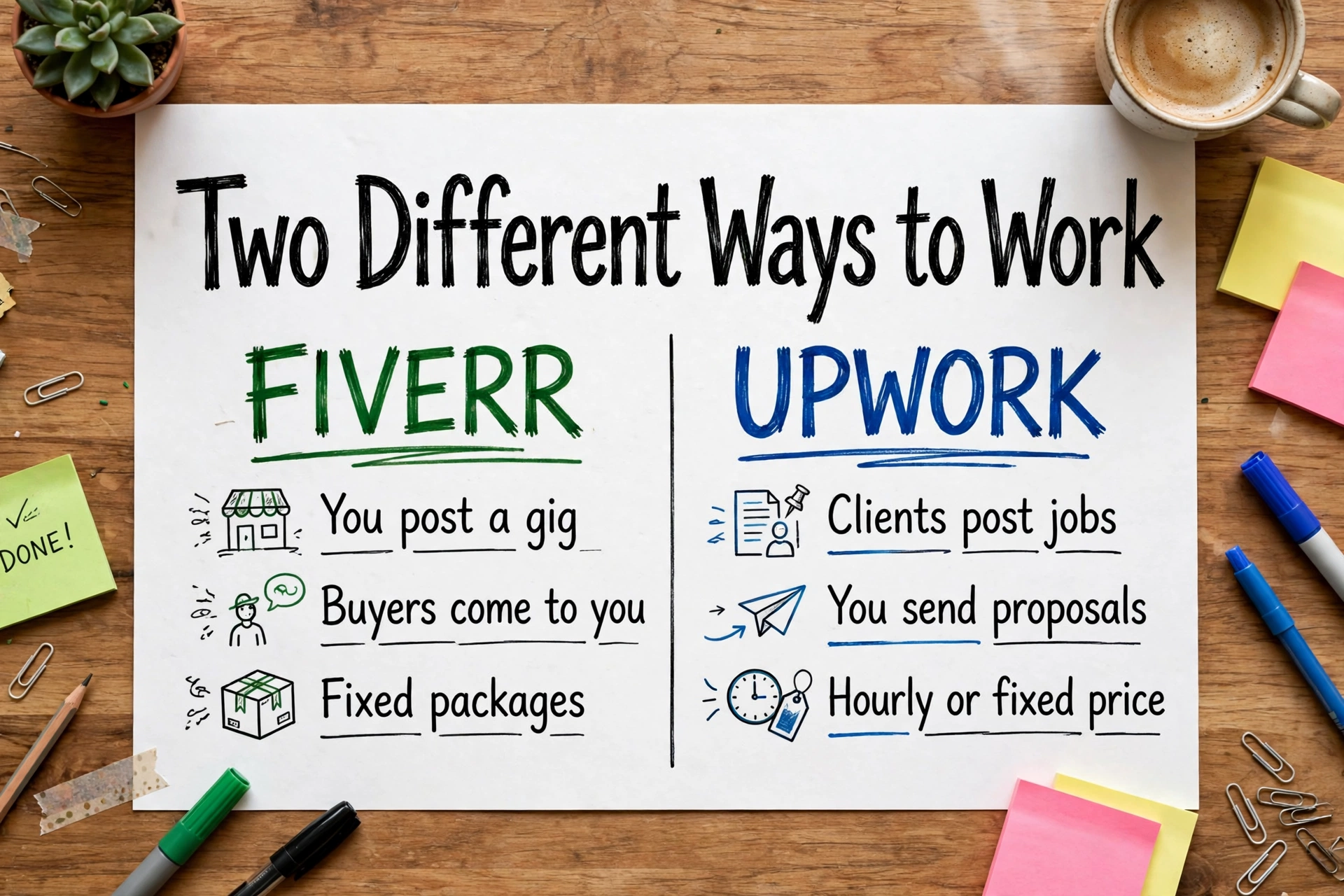
- Fiverr: You create “gigs” — packaged services with fixed prices, like “I will design a minimalist logo for $50.” Buyers search, find your gig, and order. Clients come to you.
- Upwork: Clients post jobs — “Need a logo designer for a startup rebrand.” You write proposals and bid. You go to clients.
That single difference shapes everything in this decision: how fast you earn, what skills you need beyond your craft, and how much money you spend before your first dollar arrives.
Disclosure: Some links in this article may earn Dear Thoughts a commission if you buy through them, at no extra cost to you. No company pays for placement — our rankings and verdicts are editorial.
How we compared them
When: fee structures, service charges and plan details were checked against Fiverr’s and Upwork’s official pages in October 2026 (credibility re-check on October 13, 2026). The criteria, weighted: fees and take-home pay 30%, ease of getting started 25%, quality of jobs and clients 20%, payment protection 15%, support and disputes 10%. Fees lead because for a beginner the difference between the two platforms shows up in earnings before it shows up anywhere else. Observed vs claimed: every fee and percentage is the platform’s own published figure, linked to its official page; judgements about landing work and client quality are editorial, drawn from how the two marketplaces are structured.
Fiverr vs Upwork 2026: fees compared
Fees are where the math gets interesting:
| Fiverr | Upwork | |
|---|---|---|
| Seller fee | 20% flat on every order | Contract-based: 0–15% (typically around 10%) |
| Cost to start | $0 — free signup, no bidding costs | Connects cost money ($0.15 each in bundles; per-proposal cost varies by job) |
| On a $100 job | You keep $80 | You keep ~$90 (minus Connects spent) |
| On a $5,000 client relationship | You keep $4,000 | You keep ~$4,500 |
Fiverr’s 20% never drops, no matter how much you earn. Upwork’s fee is now set per contract — 0–15% depending on the contract, typically around 10% — and locked in when the contract starts, so it no longer drops the longer you work with a client. In the fee battle, Upwork’s typically lower fee wins on larger contracts, while Fiverr’s zero upfront cost wins for beginners with empty pockets.
The hidden cost in this comparison is Upwork’s Connects system. You spend Connects to submit proposals — real money, before any client has even replied. Connects cost $0.15 each and are sold in bundles, and each proposal costs a variable number of Connects depending on the job. New accounts may receive a one-time bonus of 50 Connects, which runs out fast. It is entirely possible to burn through $50 of Connects in a week without a single response. Fiverr costs nothing until you earn.
Fiverr vs Upwork 2026: getting your first client
This is the deciding factor for most beginners.
On Fiverr, your job is to build a gig that ranks in search. Good title, clear packages, strong portfolio samples, competitive starting price — then buyers find you while you sleep. Your first order can arrive without you ever pitching anyone. The challenge is standing out among huge numbers of sellers in popular categories.
On Upwork, your job is to write proposals that win. Many job postings attract dozens of proposals, and as a beginner with no reviews, you are competing against established freelancers from day one. Winning requires excellent proposal writing — a skill separate from your actual craft. The challenge is getting noticed at all.
For the Fiverr vs Upwork 2026 beginner question, the verdict is clear: Fiverr is easier to start. No bidding, no upfront spend, buyers come to you. Upwork demands more skill and more patience before the first paycheck.
Fiverr vs Upwork 2026: earning potential
Here the comparison flips. Reported 2026 ranges vary widely depending on niche, effort, and timing — some freelancers report:
- Fiverr beginners: some report $100–$500/month in the first few months, growing to $500–$5,000/month once gigs rank, though results vary widely. Fiverr Pro sellers in premium categories can charge thousands per project.
- Upwork beginners: some report $150–$600/month early on, with a possible path to $2,000–$15,000/month through long-term contracts and hourly work — though results vary widely.
Upwork’s ceiling is higher because its clients post bigger budgets and hire for ongoing work — a $3,000/month retainer client is common on Upwork and rare on Fiverr. But Fiverr’s floor is more accessible: many beginners find it easier to make their first $100 there.
One caution for the Fiverr vs Upwork 2026 earnings picture: basic writing and design gigs have been squeezed by AI tools. General “I will write articles” gigs declined sharply as buyers turn to AI for commodity content. The freelancers thriving on both platforms in 2026 sell judgment, not just output — strategy, editing, custom development, and specialized design. Our beginner’s freelancing roadmap for 2026 covers which skills are actually AI-resistant this year.
Fiverr vs Upwork 2026: which fits your work style?
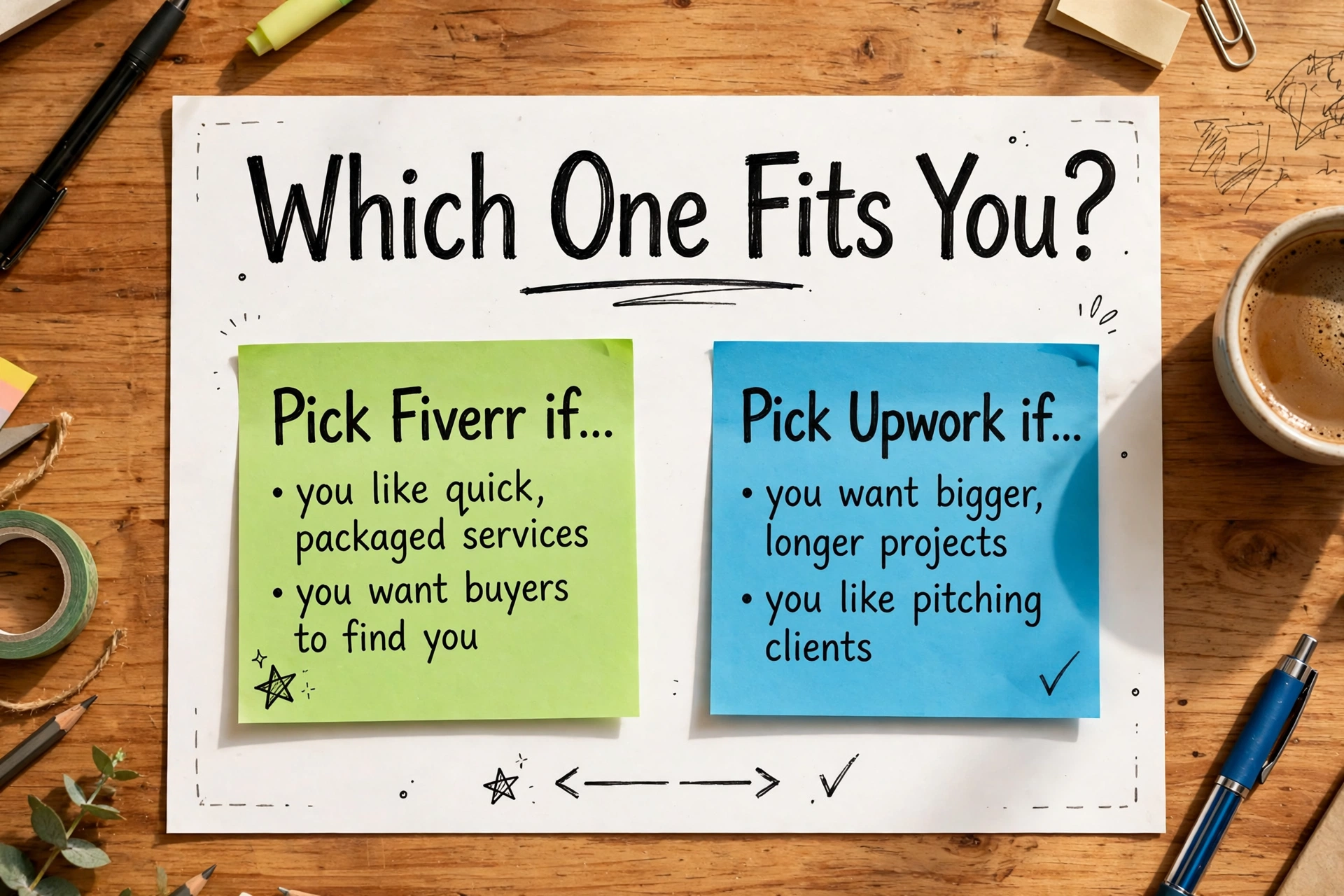
| Choose Fiverr if… | Choose Upwork if… |
|---|---|
| You want buyers to come to you | You are good at pitching and proposals |
| You sell packaged, repeatable services | You sell custom, consultative work |
| You are starting with $0 budget | You can invest in Connects and outreach |
| You prefer quick gigs and fast turnover | You prefer long-term client relationships |
| Your services fit in the $50–$500 range | Your projects run $500–$50,000+ |
The answer also depends on your craft. Designers doing one-off logos, video editors selling fixed packages, and developers offering templated setups (Shopify, WordPress, Webflow) tend to do well on Fiverr. Consultants, custom developers, and writers selling ongoing retainers tend to do better on Upwork.
Fiverr vs Upwork 2026: which skills win on each platform?
Not every skill performs equally in the Fiverr vs Upwork 2026 contest. Where your craft lands determines which platform rewards you faster.
Skills that thrive on Fiverr: logo and brand identity design, video editing and shorts repurposing, voiceovers, WordPress and Shopify setup, social media templates, and SEO audits. The pattern is clear — packaged, repeatable, visual deliverables with a fixed scope. A buyer can look at your gig, understand exactly what they get, and click order.If video editing is your craft, see our roundup of the best video editing apps in 2026.
Skills that thrive on Upwork: custom web and app development, copywriting retainers, marketing strategy, data analysis, virtual assistance, and consulting. These need conversation before commitment — exactly what Upwork’s proposal and interview flow is built for. Clients with $2,000+ budgets do not click “buy now”; they post a job and vet candidates.
The AI squeeze affects both. Commodity writing, basic graphic design, and simple data entry face brutal price pressure from AI tools on each platform. The freelancers winning the Fiverr vs Upwork 2026 game in these categories moved upmarket: editors who polish AI drafts, designers who art-direct, developers who architect. Sell judgment and taste, not keystrokes.
If your skill is not listed, test it on Fiverr first — a gig costs nothing to create, and search impressions will tell you within weeks whether buyers want it. That zero-cost experiment is Fiverr’s superpower for beginners choosing between the platforms.
The 2026 strategy: start on Fiverr, graduate to Upwork
Ask experienced freelancers about Fiverr vs Upwork 2026 and many will tell you the same thing: it is not either/or. One widely recommended play in 2026 is sequential:
- Months 1-3: Fiverr. Zero cost to start, buyers come to you, and every completed order builds reviews and portfolio pieces. Get your first 10-20 reviews here.
- Months 3-6: Add Upwork. Now you have a portfolio, testimonials, and some cash flow to fund Connects. Your proposals convert far better with proof attached.
- Month 6+: Run both. Fiverr for packaged services and passive order flow; Upwork for high-value contracts and retainers. Different audiences, different project types, two income streams.
This Fiverr vs Upwork 2026 ladder works because each platform covers the other’s weakness: Fiverr gives you momentum when you have nothing, and Upwork gives you scale once you have proof.
Fiverr vs Upwork 2026: mistakes beginners make
On Fiverr: pricing too low to escape the race to the bottom, copying top sellers’ gig titles word for word, and offering ten unrelated services instead of one sharp specialty. Also: ignoring buyer requests and gig SEO — Fiverr is a search engine, and gigs that do not rank do not sell.
On Upwork: blasting generic proposals (clients smell templates instantly), bidding on everything instead of jobs you can genuinely win, and quitting after twenty unanswered proposals. Upwork rewards targeted, well-researched pitches — ten thoughtful proposals beat a hundred generic ones.
On both: treating the platform as the business. Algorithm changes, account reviews, and fee hikes happen. The freelancers who last build direct client relationships and an email list alongside their platform income — the same diversification logic behind building passive income streams with AI in 2026.
Fiverr vs Upwork 2026: getting paid
Fees get all the attention in the Fiverr vs Upwork 2026 debate, but when you get your money matters just as much when you are starting out.
Fiverr holds your earnings for a 14-day clearance period after each order completes (7 days for top-rated sellers). That means your first paycheck arrives a full two weeks after your first delivery — painful when you need cash flow, but predictable once orders roll regularly. Withdrawals to PayPal, bank transfer, or the Fiverr Revenue Card are straightforward.
Upwork runs on weekly billing cycles. Hourly contracts bill each Monday for the previous week, with earnings available about ten days later; fixed-price funds are released five days after the client approves a milestone. The weekly rhythm typically feels faster to your pocket than Fiverr’s clearance for ongoing work, though fixed-price timing still depends on your client’s responsiveness.
For beginners, Upwork’s weekly rhythm feels better once work is flowing, but Fiverr’s predictability wins during the drought between first orders. Either way, keep a small buffer: neither platform pays instantly, and your first month on either one is often the slowest.
Fiverr vs Upwork 2026: frequently asked questions
Which is easier for beginners: Fiverr or Upwork?
Fiverr. No bidding, no upfront costs, and buyers find your gigs. Upwork requires winning competitive proposals before you earn anything, which is a steeper climb with zero reviews.
Which platform pays more?
Upwork, on average — higher per-project budgets plus a typically lower 10% fee. At $5,000 earned from one client, Upwork’s typical 10% fee saves you roughly $500 versus Fiverr’s flat 20%. Top Fiverr Pro sellers earn comparable amounts, but they are the exception.
Can I use Fiverr and Upwork at the same time?
Yes — many experienced freelancers do. Use Fiverr for quick packaged services and Upwork for larger long-term projects. Just manage your workload so deadlines never slip on either side.
How much does it cost to start on each?
Fiverr: $0. Upwork: effectively $0 to join, but proposals cost Connects ($0.15 each in bundles, with per-proposal costs varying by job), so budget $20–$50 for your first serious round of applications.
Is Fiverr only for cheap $5 work?
Not anymore. Fiverr Pro brought in high-budget clients, and sellers in web design, animation, and business consulting charge thousands per project. The $5 era ended years ago.
How long until the first client on each platform?
Timelines vary widely. On Fiverr, some beginners report landing their first order within 2–6 weeks with a well-optimized, competitively priced gig — others take longer. On Upwork, some freelancers report 3–8 weeks of consistent proposing before the first contract, since you are competing on every bid. One of the most reliable paths on either platform is the same: a sharp niche, strong samples, and daily activity.
The bottom line on Fiverr vs Upwork 2026
So, Fiverr vs Upwork 2026 — which should you choose? If you are starting from zero, start with Fiverr. It costs nothing, buyers come to you, and your first reviews arrive faster. If you have skills, a portfolio, and patience for outreach, Upwork pays more through bigger projects and typically lower fees.
But the real lesson is that the platform is just the venue — the business is you. Pick one, commit for ninety days, deliver excellent work, collect reviews, then expand to the other. Freelancers who treat either platform as a ninety-day sprint instead of a lottery ticket tend to be the ones still earning a year later.
Ready to start? Read our complete beginner’s roadmap to freelancing in 2026 for the full setup — choosing skills, pricing your first gigs, and getting clients beyond the platforms.
Article updates
- October 13, 2026 — Credibility review: added official sources for pricing, fees, and platform policies; softened absolute claims.



[…] Related reading: we compared the two biggest platforms in Fiverr vs Upwork in 2026: Which Platform Is Better for Beginners? […]
[…] harder to reach, but if you already write about business or freelancing, the fit is natural. Our Fiverr vs Upwork guide shows how freelancer-focused content attracts exactly the readers B2B tools pay […]
[…] dollars freelancing the skill they blog about. If writing is your lane, our freelancing roadmap and Fiverr vs Upwork comparison show exactly where beginners land their first clients. Treat the blog as the asset and income as […]
[…] with our guide on how to start freelancing, and if you’re choosing where to find clients, our Fiverr vs Upwork comparison covers both platforms […]