

If you used a chatbot in 2024, you typed a question and got an answer. In 2026, you describe an outcome — “clean up my inbox,” “prepare my weekly report,” “find the cheapest flights for Friday” — and something quietly goes and does it. That shift, from software that answers to software that acts, is the story of AI agents 2026.
In this article
- What an AI agent actually is
- How AI agents work
- AI Agents 2026: Where They Are Being Used
- Single agents vs multi-agent systems
- The honest downsides: cost, failures, and security risks
- How to start using AI agents yourself
- Building With AI Agents 2026: What to Learn Next
- AI Agents 2026: Frequently Asked Questions
- The Bottom Line on AI Agents in 2026
- Sources and Further Reading on AI Agents
- Article updates
The numbers tell it plainly. In KPMG’s Q3 2026 AI Pulse Survey, 62% of companies with more than a billion dollars in revenue are now deploying or developing AI agents, up from 53% the quarter before. Agents have moved from conference-stage demos into payroll, schedules, and customer workflows.
This AI agents 2026 guide explains what AI agents actually are, how they work under the hood, where they’re being used, what they cost, where they fail — and how you, as a regular person with no engineering background, can start using them this week.
What an AI agent actually is
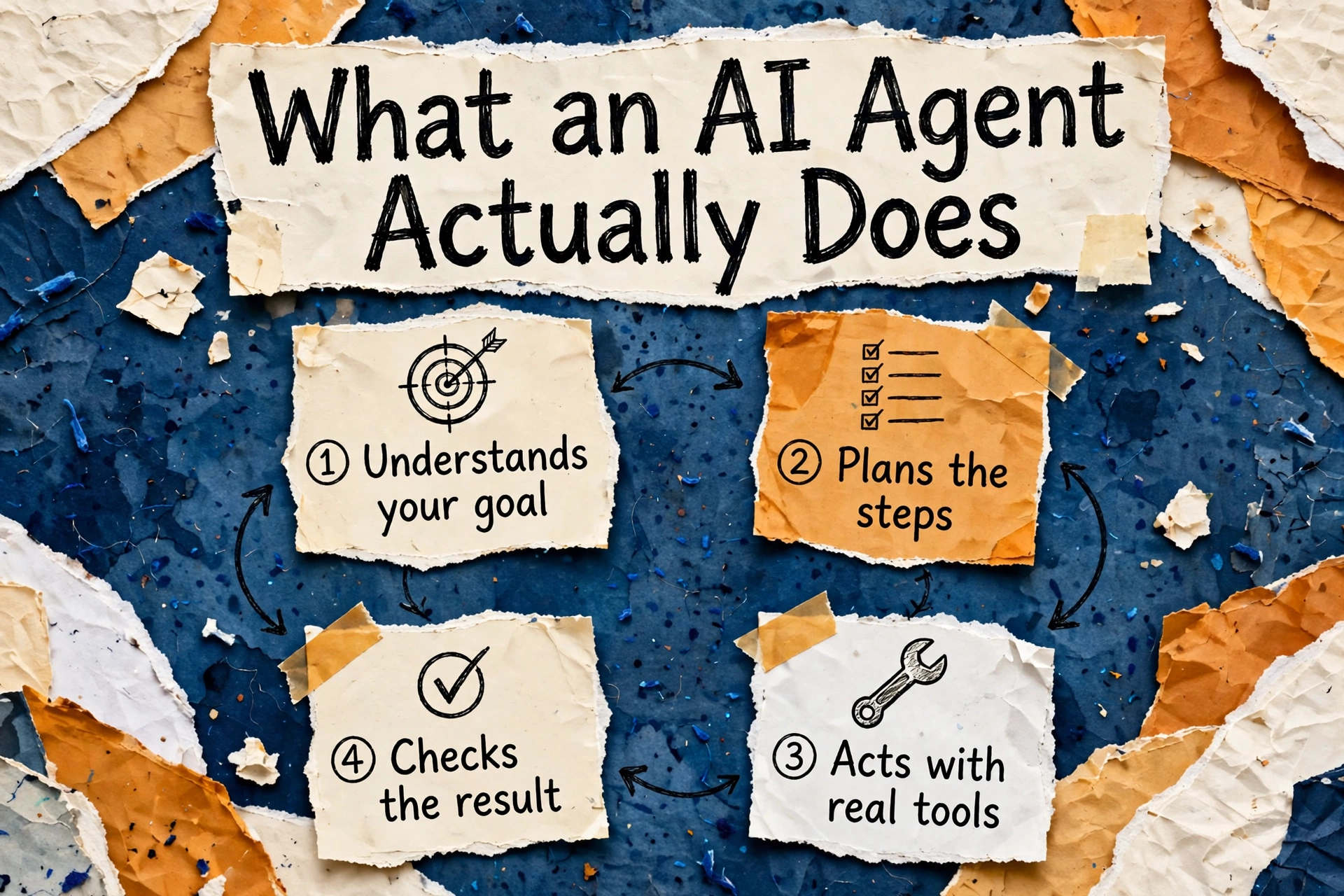
An AI agent is software that pursues a goal on your behalf. You give it an objective, and it takes a series of steps — gathering information, making decisions, using tools — until the goal is reached or it runs into something it can’t resolve.
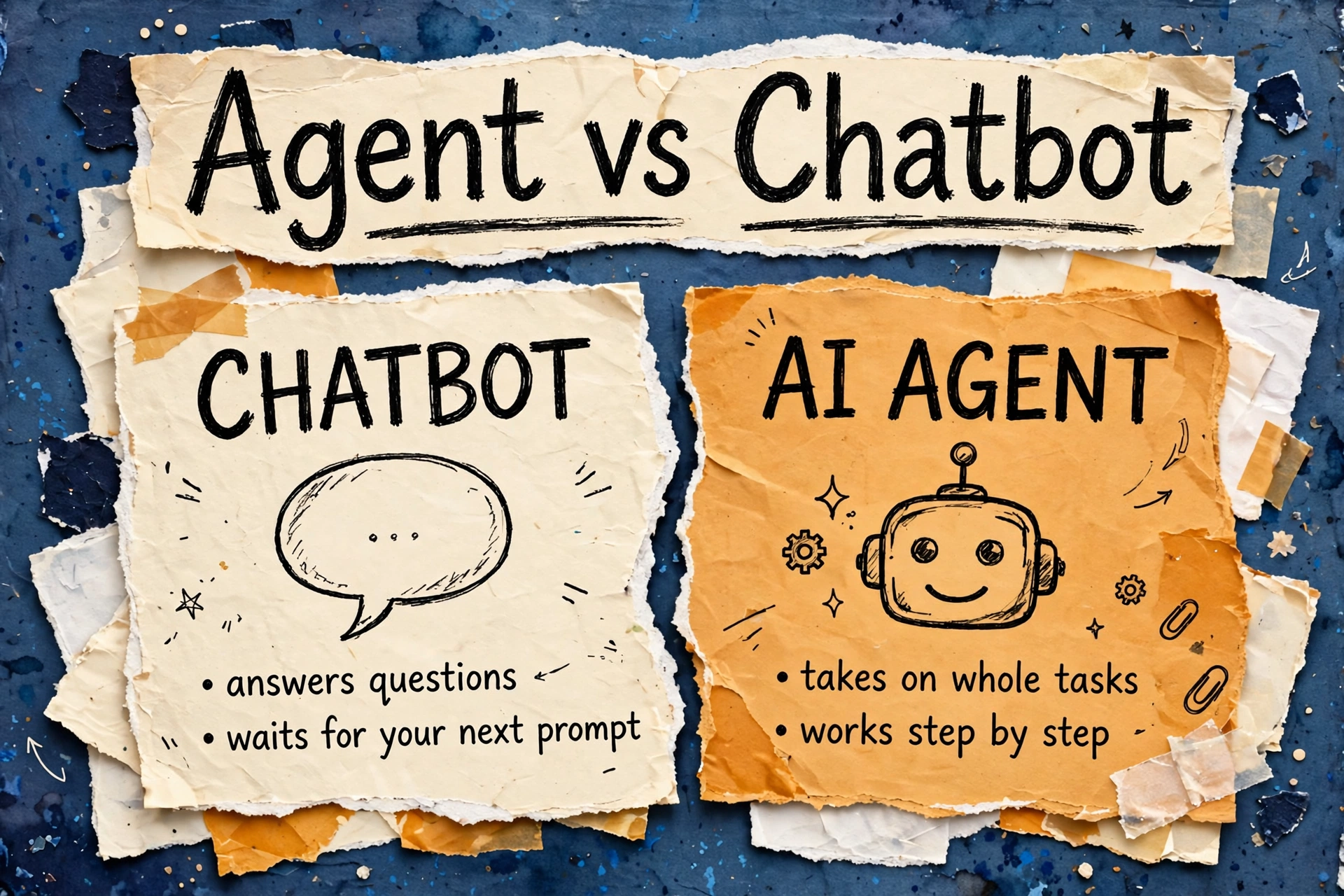
The concrete difference from a chatbot is agency. A chatbot waits for your prompt, produces text, and stops. An agent decides what to do next without being told each step. Ask a chatbot to “plan my trip” and you get an itinerary written out. Ask an agent and it may check your calendar, search flight prices, compare hotels, and come back with booked options awaiting your approval.
Most agents in the AI agents 2026 landscape are semi-autonomous. They work inside boundaries: a set of tools they’re allowed to touch, a budget of time and money they may spend, and checkpoints where a human must approve before anything irreversible happens. This “human-in-the-loop” design is not a limitation of the technology — it’s the standard way responsible teams deploy it.
How AI agents work
Underneath every agent is a simple loop: perceive, plan, act. The agent perceives by reading its environment — your message, a document, a webpage, sensor data. It plans by using a large language model to reason about what to do next. It acts by calling tools: web search, a calendar API, a code interpreter, a database.
In the AI agents 2026 stack, tools are what separate agents from chatbots. A model alone can only produce text; tools let it produce effects in the world. An agent that can search the web, read your files, and send email is meaningfully more capable than one that can only talk — a core reason AI agents 2026 feel like such a leap, even when both run on the same underlying model.
Memory comes in two forms. Short-term memory is the conversation and context the agent holds while working — what it has tried, what it has learned. Long-term memory is stored across sessions: your preferences, past projects, facts about your business. The better the memory design, the less you have to repeat yourself.
When a task is complex, the agent breaks it down. Planning a product launch might decompose into market research, draft writing, image generation, and scheduling — each handled as a sub-task with its own perceive-plan-act cycle. Modern agents also self-correct: when a tool call fails, they observe the error and try another approach, much like you would.
One practical consequence worth knowing: this loop is computationally expensive. Gartner estimates that agentic models require between 5 and 30 times more tokens per task than a standard GenAI chatbot. Every step of reasoning, tool call, and retry burns compute — which is why agentic features cost more and why providers meter them.
AI Agents 2026: Where They Are Being Used
The AI agents 2026 enterprise adoption wave is real. KPMG’s Q3 2026 survey found 62% of large companies deploying or developing agents, with multi-agent systems jumping to 25% adoption, from 6% in each of the previous two quarters. The examples are increasingly concrete rather than aspirational.
Walmart estimates its AI-directed task management reduced shift-planning time from 90 minutes to 30 minutes. JPMorganChase expanded access to its internal LLM platform to 200,000 employees, turning agents into everyday productivity infrastructure. Morgan Stanley reports 98% of Financial Advisor teams have adopted its AI Assistant. These are not pilots — they are rollouts measured in headcount.
Deloitte estimates the global agentic AI market could reach $35 billion in 2030, up from a projected $8.5 billion in 2026 — or as high as $45 billion if enterprises orchestrate agents well, which is one reason many major software vendors are embedding AI agents 2026 features into products their customers already pay for.
For ordinary people, AI agents 2026 are arriving inside familiar tools rather than as standalone products:
- Email and calendar: agents that triage inboxes, draft replies, and schedule meetings from a one-line instruction.
- Research: “deep research” features that spend ten minutes reading dozens of sources and return a structured brief.
- Shopping and travel: agents that compare prices across sites and monitor for drops.
- Coding: agents that write, test, and fix code in a loop — one of the most mature consumer categories.
- Content and marketing: agents that draft posts, generate images, and queue them to a schedule.
If you already use any of the AI tools covered in our earlier roundup, check their AI agents 2026 updates — there’s a good chance an agent mode has appeared inside a product you already know. Agents are even moving into the physical world: in October 2026, AI agents designed an obstacle course that taught a robot duck to walk in simulation, long before the policy ever ran on real hardware.
Single agents vs multi-agent systems
A single agent does everything itself: it plans, calls tools, and delivers the result. This works well for bounded tasks like summarizing documents or booking travel. It’s simpler to run, cheaper, and easier to debug.
A multi-agent system splits the work among specialized agents coordinated by an orchestrator. One agent researches, another writes, a third fact-checks, a fourth formats. Each can use a different model or toolset suited to its role.
Multi-agent setups shine on complex, multi-stage work — think due diligence, software projects, or content pipelines. But they multiply the cost and the failure modes: agents can misunderstand each other, duplicate work, or loop. That trade-off is why adoption is still only 25% even among large enterprises, and why most individuals exploring AI agents 2026 should start with single agents.
| Single agent | Multi-agent system | |
|---|---|---|
| Best for | Bounded, repeatable tasks | Complex, multi-stage projects |
| Cost | Lower — one reasoning loop | Higher — many loops, coordination overhead |
| Reliability | Easier to test and debug | More failure modes between agents |
| Setup effort | Often built into apps you use | Usually needs deliberate design |
The honest downsides: cost, failures, and security risks
The enthusiasm around AI agents 2026 is real, but so are the bills. Cost discipline is tightening — 74% of organizations now include cost reviews in AI approval processes, and 43% have implemented usage or token budgets — and agents, which require 5 to 30 times more tokens per task than standard chatbots, are a major reason. An agent that loops through twenty tool calls to complete one task can cost orders of magnitude more than the chat interaction it replaced. Anyone deploying agents needs metering, budgets, and kill switches from day one.
Then there is the failure rate. Gartner expects more than 40% of agentic AI projects to be cancelled by the end of 2027, citing cost, unclear value, or inadequate risk controls. Many pilots stall because the agent works in demos but behaves unpredictably on real, messy data — or because nobody defined what success looks like before building.
Security deserves its own paragraph in any AI agents 2026 discussion. An agent with access to your email, files, and browser is a powerful tool and a powerful target. Prompt injection — malicious instructions hidden in webpages or documents the agent reads — can trick it into leaking data or taking unauthorized actions. The standard defenses are least-privilege access (the agent can only touch what it needs), human approval for irreversible actions, and audit logs of everything the agent did.
None of this means agents are a fad. It means they are infrastructure: genuinely useful, genuinely expensive, and genuinely in need of adult supervision. The teams most likely to win with AI agents 2026 are those that measure cost per task, keep humans in the loop on anything irreversible, and start with narrow, well-defined jobs.
Disclosure: Some links in this article may earn Dear Thoughts a commission if you buy through them, at no extra cost to you. No company pays for placement — our rankings and verdicts are editorial.
How to start using AI agents yourself
You don’t need to code to join the AI agents 2026 wave, and you don’t need a new subscription on day one. The most practical path is to use agent features inside tools you already have:
Running a business? We put together 12 ways AI agents can save small businesses time and money — customer support, invoicing, bookings, lead follow-up — with the real prices for each.
- Turn on agent mode in your AI assistant. The major assistants now ship an agent or “deep research” mode. Try it on a real task: “Research the three best budget microphones under $100 and summarize the trade-offs.”
- Automate one repetitive workflow. Pick something you do weekly — inbox triage, meeting notes, expense summaries — and let an agent draft it for your review. Keep the approval step; that’s the point.
- Connect one or two tools. An agent linked to your calendar and email is dramatically more useful than a standalone one. Grant the minimum access it needs and review what it touches.
- Set a spending cap. If the platform offers usage limits or budgets, turn them on before your first long task. Agent loops can surprise you.
- Evaluate before you expand. After two weeks, ask: did this save time net of the reviewing and fixing? Expand only the workflows with a clear yes.
A useful mindset shift: stop asking “what can this agent do?” and start asking “what do I do every week that follows a pattern?” Patterned, repeatable work is where agents earn their keep. One-off creative judgment is still yours.
Ready to try it yourself? Our step-by-step tutorial shows you how to build your first AI agent with no code.
Building With AI Agents 2026: What to Learn Next
If you’re a freelancer or aspiring builder, AI agents 2026 are a genuine opportunity — clients are paying for workflows, not chatbots. The good news is the entry bar is lower than it looks.
Start with no-code agent builders. Visual platforms now let you chain an agent’s perceive-plan-act loop with drag-and-drop tools: trigger on a new email, research, draft, notify. You can ship a working prototype for a client in an afternoon, which is a powerful way to start freelancing with AI services without a computer science degree.
Next, learn the fundamentals that transfer everywhere: how tool-calling works, how to write a good system prompt that constrains an agent’s behavior, how to design human-approval checkpoints, and how to log and evaluate agent runs. These four skills matter more than any single framework.
For those who code, pick one agent framework and build three small projects: a research agent, a personal productivity agent, and one multi-agent pipeline. Document the costs and failure modes of each — that honest accounting is exactly what enterprise clients are missing, and it’s what will differentiate you.
And if you’re thinking about income streams rather than client work, agents slot naturally into passive income with AI setups: content pipelines, research products, and automated storefront operations that run while you sleep — with you reviewing the outputs, not producing them by hand.
AI Agents 2026: Frequently Asked Questions
Are AI agents the same as chatbots?
No. A chatbot produces text in response to prompts. An AI agent pursues a goal by taking multiple steps — perceiving information, planning, and using tools like web search, calendars, and code execution — often without being told each step. Think of a chatbot as an advisor and an agent as an assistant that does errands.
Do I need to know how to code to use AI agents?
No. Some of the most accessible AI agents 2026 live inside products you already use — AI assistants with agent modes, email triage, research tools, and automation apps with visual builders. Coding helps if you want to build custom agents, but using them requires only clear instructions and a willingness to review their work.
How much do AI agents cost?
AI agents 2026 pricing varies widely. Built-in agent features in subscriptions you already pay for may cost nothing extra. Usage-based agent platforms charge per task, and costs add up because agentic models require 5 to 30 times more tokens per task than standard chatbots (Gartner). Start with capped, built-in features before paying per-task.
Are AI agents safe?
They’re as safe as their permissions. The main risks are prompt injection (hidden instructions in content the agent reads), excessive access to your accounts, and actions taken without review. Mitigate with least-privilege access, human approval on irreversible actions, and audit logs. Never give an agent credentials or access you wouldn’t give a new hire.
Will AI agents replace jobs?
They’re reshaping tasks more than erasing whole jobs. Agents absorb repetitive, pattern-based work — triage, drafting, scheduling, first-pass research — which shifts human effort toward judgment, relationships, and exceptions. The people thriving in 2026 may be those who learn to direct agents rather than compete with them on routine output.
The Bottom Line on AI Agents in 2026
AI agents 2026 are past the demo phase and into the messy reality of real work: genuinely useful, genuinely expensive, and genuinely in need of supervision. Enterprises are deploying them at scale — 62% of large companies and counting — while individuals can start today with agent features already inside familiar tools.
The winning approach is unglamorous: pick one repetitive workflow, give an agent narrow permissions, keep approval on irreversible steps, and measure whether it actually saves time. Do that, and agents become leverage. Skip it, and you join the 40% of projects Gartner expects to be cancelled. The technology rewards the deliberate.
Sources and Further Reading on AI Agents
- 62% of Large Enterprises Now Deploying AI Agents, KPMG Finds — AutonAI News
- AI Economy 2026: Falling Token Costs, $702 Billion Compute Boom, and AI Agents Reshape Enterprise IT — InfotechLead
Related reading: see how the top assistants compare in our Best AI Chatbot 2026: ChatGPT vs Claude vs Gemini guide.
Article updates
- October 13, 2026 — Credibility review: added official sources for pricing, fees, and platform policies; softened absolute claims.



[…] freelancing, this is a natural high-value service to add — and our beginner’s guide to AI agents is a useful primer on the underlying […]
[…] Start free, pay for the one you use daily, and let your actual work — not the launch hype — decide which deserves the title in your daily setup. If you want to go deeper on what these tools can actually do for your productivity, read our guide to the top 10 AI tools saving hours of manual work in 2026, and if you are curious where assistants go next, see our beginner’s guide to AI agents in 2026. […]
[…] or it hits something that needs your approval. If you want the deeper explainer first, our guide to AI agents in 2026 covers how they work under the hood. This article is the practical version: where the hours and the […]
[…] and developers can use skills through the API. If you are new to that side of things, our guide to AI agents for beginners covers the basics skills plug […]
[…] that sounds like science fiction, it is really just our AI agents guide applied to a new domain: agents that plan, use tools, and check results — except the […]
[…] and it decides the order of steps itself. If that distinction is fuzzy, our beginner explainer on what AI agents are and how they actually work covers it properly — this guide assumes the idea and gets […]