


If you are weighing up blog vs YouTube for making money in 2026, here is the short answer most comparison posts skip: neither one pays you for starting. YouTube pays you for passing a gate. A blog pays you for owning an asset nobody can take away. Which one is “better” depends on which of those two games you are actually willing to play for the next twelve months.
In this article
This guide compares the two properly: the real entry requirements (taken from Google’s own pages, not from guru videos), what each one costs to start, how long the first money realistically takes, and the catch nobody mentions until it happens to them. At the end there is a straight verdict for different types of people, because “it depends” is only useful if someone tells you what it depends on.
The short answer
Choose YouTube if you are comfortable on camera (or willing to run a faceless channel), you want the faster of the two routes once you qualify, and you can publish consistently for months before seeing a rupee, dollar or pound. Choose a blog if you would rather write than perform, you want the cheapest possible start, and you like the idea of owning the whole thing — your site, your content, your income streams — instead of renting space on someone else’s platform.
One timing detail matters this year: YouTube has officially announced that from February 1, 2027, new applicants for ad revenue will need 8,000 watch hours or 20 million Shorts views — double the current bar. Creators already in the program are not affected. So if YouTube is your pick, starting now is genuinely easier than starting next year. That is not hype; it is on YouTube’s own blog.
How we compared them
So this stays honest, here is exactly how this comparison was scored, and where the facts come from:
- Entry requirements and revenue shares are taken from YouTube’s and Google’s official help pages, linked throughout, and were checked on November 1, 2026.
- Criteria weighting: entry difficulty 25%, startup cost 20%, time to first income 25%, long-term control and ownership 20%, earning ceiling 10%.
- Timelines are editorial estimates based on how these platforms typically reward consistent work. Google publishes no earnings rates for either platform (more on that below), so anyone quoting you an exact income figure is guessing — including us, if we tried. We will not.
The YouTube gate: what it actually takes to get paid
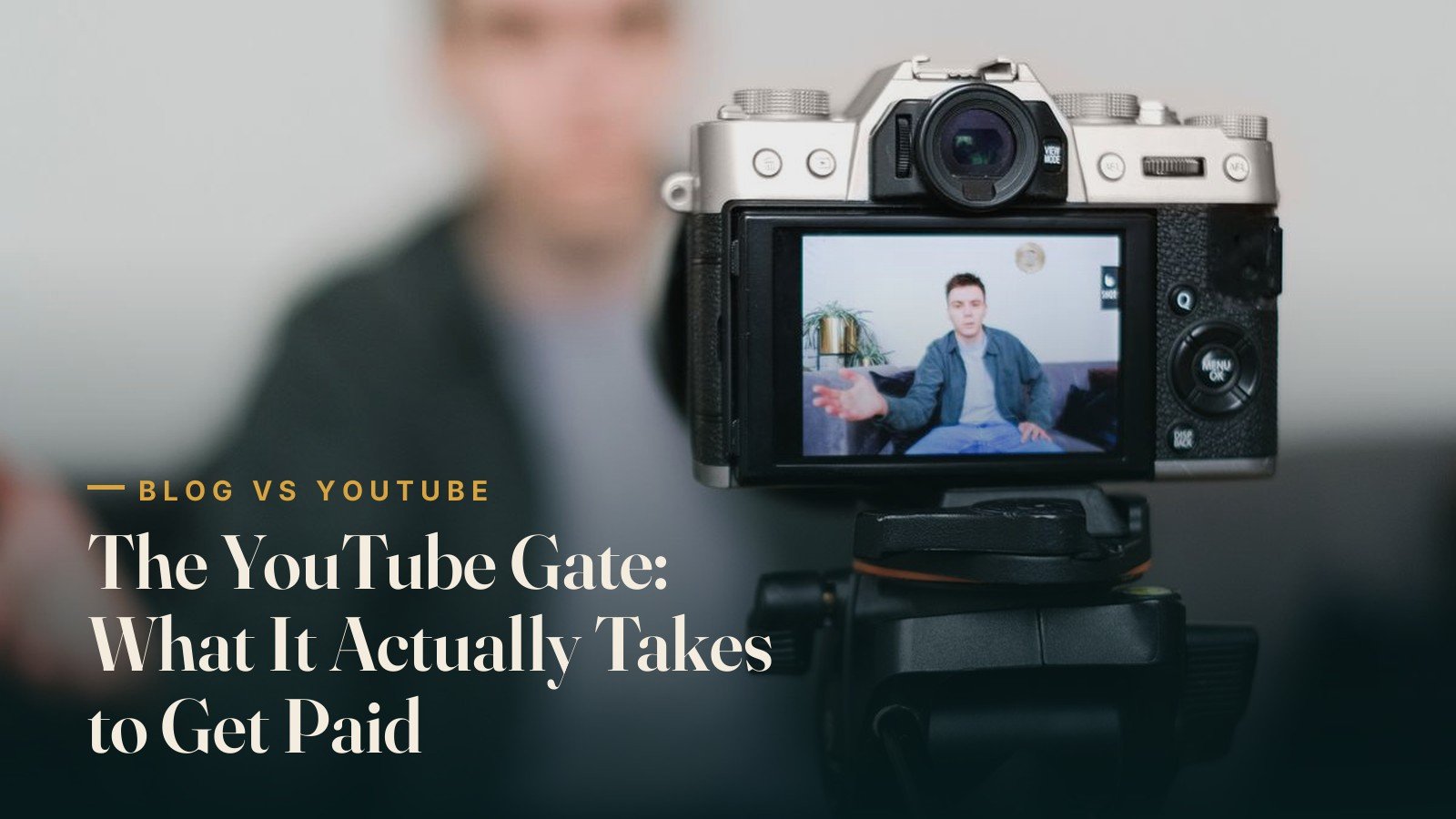
YouTube does not pay beginners. Before ad money exists, your channel has to be accepted into the YouTube Partner Program, and the full tier — the one with ad and Premium revenue — requires one of these:
- 1,000 subscribers + 4,000 qualifying watch hours in the last 12 months, or
- 1,000 subscribers + 10 million qualifying Shorts views in the last 90 days.
Your channel is then reviewed by a human process against the channel monetization policies. The rule with real teeth is the reused content policy: your content must be original and “authentic,” and repurposing other people’s content without significant original commentary can get the whole channel rejected or demonetized — even if you had permission to use the material. A sister policy, renamed “inauthentic content” in July 2025, targets mass-produced, templated content. If your plan was uploading compilations or AI-voiced slideshow videos at scale, this is the wall you will hit.
Once you are in, the money split is fixed and public. According to YouTube’s partner earnings overview, you keep:
- 55% of net ad revenue on regular videos
- 45% of your allocated share from Shorts
- 70% of fan funding — channel memberships, Super Chat, Super Thanks and similar features
And YouTube says this in the same document, in plain words: “There are no guarantees under the YouTube partner agreement about how much or whether you’ll be paid.” Hold on to that sentence. It is the most honest line in the whole creator economy. For the YouTube side in full detail — thresholds, revenue shares and realistic first-year numbers — see our breakdown of how much YouTube actually pays beginners.
The smaller gate most people miss
There is also an expanded Partner Program tier at 500 subscribers (with 3,000 watch hours or 3 million Shorts views, plus 3 recent public uploads). It unlocks fan funding and Shopping features, but not ad revenue — the 1,000-subscriber bar still applies for that. One important catch for readers outside the major markets: the expanded tier is only available in a listed set of countries, and Pakistan is not on that list as of November 2026. Check the page for your country before counting on it.
If you are starting from zero, our full guide on how to start a YouTube channel in 2026 walks through the setup properly. And if the camera is the part you dread, a faceless channel using a good voice tool is a legitimate route — we compared the options in our guide to the best free text-to-speech tools for YouTube beginners.

The blog gate: there almost isn’t one
A blog’s main ad network, Google AdSense, has a far simpler front door. Google’s AdSense eligibility page boils down to this: if you have your own original content that meets the policies and you are 18 or over, you can sign up. That is close to the whole test.
Notice what is not on that page: no minimum traffic, no minimum number of posts, no minimum site age. Articles claiming you officially need “30 posts and 10,000 visitors” before AdSense are inventing rules Google never published. (Getting approved still involves a review of your site’s quality, and approval is never guaranteed — but the published eligibility bar itself is low.)
The bigger difference is that ads are only one of a blog’s income routes, and none of the others have a gatekeeper at all:
- Affiliate marketing — recommend products, earn commission. No threshold, no application to Google. Our affiliate marketing beginner’s guide covers how it works.
- Digital products — an ebook, template or course sold from your own pages, where you keep nearly everything.
- Services — the blog becomes proof of skill that sells your freelancing. Many bloggers earn their first money this way, long before ads matter.
This is also where blogs quietly beat YouTube on control: every one of those income streams is yours. We explored the AI-assisted version of this in our piece on passive income with AI — the principle is the same with or without AI.
Startup costs, side by side
| Cost | Blog | YouTube channel |
|---|---|---|
| Platform | Free to start (e.g. a free WordPress.com plan with a subdomain); paid plans with a custom domain start from a few dollars a month — WordPress.com’s pricing page lists plans starting at $2.75/month billed long-term. Self-hosted WordPress plus budget hosting is in the same small range. | Free. Uploading costs nothing. |
| Equipment | The computer or phone you already own. | The phone you already own is enough to start. A basic microphone helps more than a camera upgrade. |
| Ongoing tools | Optional: a theme, an email service, a design tool. | Optional: editing app, thumbnail tool, music licensing. |
| The real cost | Your writing time, for months, before revenue shows up. | Your filming and editing time — usually several hours per video — before you even reach the gate. |
On paper YouTube is free and a blog costs a little. In practice both are paid for in hours, and the blog’s hours are usually fewer per piece of content. A solid article might take two to four hours. A solid video — script, record, edit, thumbnail, upload, description — rarely takes less.
Time to first money: the honest version
Here is where we refuse to do what most posts on this topic do. There is no official earnings rate for either platform. Google publishes percentage splits for YouTube and nothing at all for websites — no fixed amount per thousand views exists anywhere in Google’s documentation. Every “YouTube pays $3–$30 per 1,000 views” chart you have seen is stitched together from individual creators’ screenshots in different niches, countries and months. Directionally useful, officially meaningless.
What can be said honestly:
- YouTube: zero ad income until you pass the gate, and passing it takes most consistent beginners a few months to over a year. After that, income scales with views — fast if a video takes off, painfully slow if not. The February 2027 threshold rise makes the gate higher for anyone who waits.
- Blog: AdSense can be applied for early, but meaningful ad income needs search traffic, and search traffic for a new site typically builds over 6–12 months of consistent publishing. Affiliate and service income can arrive much earlier than ads — sometimes from the first few articles, if the intent is right.
- Both: the people who earn in month two are rare enough to be marketing material. Plan for a slow first six months on either path and you will not be disappointed; quit in month two and neither platform had a chance.
Our guide on how to start a blog in 2026 is realistic about this timeline too — the pattern is identical on both platforms: consistency compounds, sporadic effort does not.
The catch on each side
YouTube’s catch is control. Your channel lives on rented land. The reused and inauthentic content policies apply to your channel as a whole, monetization can be removed, and YouTube’s own help pages note it may turn off monetization on channels that have not uploaded for six months or more. None of this makes YouTube a bad bet — it is still the biggest discovery engine for video on earth — but your audience belongs to the platform first and to you second.
The blog’s catch is discovery. Nobody is handed an audience. There is no recommendation algorithm pushing your article to strangers the way YouTube pushes a promising video; you earn visitors through search, social sharing and time. The flip side is that everything you build — the domain, the content, the email list, the rankings — is an asset you own outright, and it can be sold, moved or kept forever.
| Factor (weight) | Blog | YouTube |
|---|---|---|
| Entry difficulty (25%) | Low gate: 18+, original content, policy compliance | High gate: 1,000 subs + watch hours/Shorts views, plus channel review (doubling for new applicants in Feb 2027) |
| Startup cost (20%) | A few dollars a month, or free to start | Free, using a phone you own |
| Time to first income (25%) | Slow for ads; faster via affiliate/services | Nothing until the gate; then scales with views |
| Control & ownership (20%) | You own the site, content and audience | Platform owns distribution; policies apply channel-wide |
| Earning ceiling (10%) | High but gradual — products and services raise it | Very high for breakout channels; most channels stay small |

So which one should you pick?
Pick YouTube if you explain things well out loud, you can commit to a weekly video for at least six months, and the idea of a video suddenly reaching 100,000 strangers excites you more than it scares you. Start before February 2027 if you can — the same effort will clear a lower gate.
Pick a blog if you think in text, you want the lowest-cost and lowest-risk start, you care about owning what you build, or your topic is the search-driven kind (“how do I fix…”, “X vs Y”, “best tool for…”) that people type into Google every day. Blogs reward exactly that intent.
Pick both, in sequence, if you are playing a long game — and honestly, this is what many successful creators end up doing. A blog article becomes a video script. A video gets embedded in the article. Each platform feeds the other, and if one changes its rules, you still have the other. Start with whichever matches your natural skill, add the second when the first is running.
What we would not do: start both on the same day as a complete beginner and split your energy in half. Two half-built platforms earn less than one finished one.
Frequently asked questions
Can I do YouTube without showing my face?
Yes. Faceless channels are common in niches like finance explainers, history, tech tutorials and motivational content. You still need to pass the same Partner Program thresholds, and your content still has to be original — a slideshow of other people’s clips with a robot voice is exactly what the reused and inauthentic content policies target. Original scripts, your own recordings and real commentary are what keep a faceless channel safe.
Does AdSense require a minimum amount of traffic?
No. Google’s published eligibility requirements ask for your own original, policy-compliant content and an applicant aged 18 or over. There is no official traffic, post-count or site-age minimum. Approval still involves a review, so a thin or unfinished site can be turned down on quality grounds.
Why do people say YouTube pays a fixed amount per 1,000 views?
Because creators share their own revenue-per-thousand-views figures, and those get averaged into charts. YouTube itself pays a percentage — 55% of net ad revenue for regular videos — so what you actually earn per thousand views moves with your niche, your viewers’ countries and the season. Treat any fixed figure as a rough anecdote, not a rate.
What changes for YouTube beginners in February 2027?
From February 1, 2027, new applicants for ad and Premium revenue sharing will need 8,000 watch hours in the last 365 days, or 20 million Shorts views in 90 days — double the current thresholds. Existing partners are unaffected, and the fan-funding and Shopping entry tier stays as it is. YouTube announced this on its official blog in August 2026.
Which makes money faster for a complete beginner?
For most beginners, the blog — not through ads, but because affiliate links and services can earn from the very first articles, with no subscriber gate in the way. YouTube pays nothing at all until the Partner Program lets you in, but once a channel is in and growing, its income can scale faster than a young blog’s. Faster start: blog. Faster scale after the gate: YouTube.
Article updates
November 1, 2026: First published. All platform requirements and revenue shares checked against YouTube’s and Google’s official help pages on this date. Note for future updates: YouTube’s announced February 1, 2027 threshold increase for new Partner Program applicants will need to be reflected in the requirements section when it takes effect.
November 2, 2026: Images updated — new cover and section images throughout.

[…] deciding between video and writing? Our honest comparison of blog vs YouTube for making money breaks down the entry rules, costs and timelines for […]