

So, how much does YouTube pay someone who’s just starting out? The honest answer has two parts. Before monetization: exactly $0, no matter how many views you get. After you join the Partner Program: most beginners earn somewhere between $1 and $10 per 1,000 long-form views, depending on their niche and where their viewers live — which means a new channel’s first monetized months are usually worth tens of dollars, not the thousands in the screenshots you see on social media. This guide breaks down the real numbers: what you need before YouTube pays you anything, how the money is calculated, what different niches actually earn per 1,000 views, and what your views could realistically be worth in your first year.
In this article
- First, the part nobody puts in the thumbnail: you earn $0 until you’re monetized
- How the money actually works: your cut, CPM and RPM
- Real numbers: what 1,000 views pay in different niches
- Worked examples: what your views could be worth
- A realistic first year, month by month
- Why two channels with the same views earn completely different money
- The money that matters more than ads when you’re small
- How and when you actually get paid
- FAQs
- How we put these numbers together
- Final recommendation
- Article updates
If you haven’t started yet, our guide on how to start a YouTube channel in 2026 covers the setup; this article picks up where that one ends — at the money.
First, the part nobody puts in the thumbnail: you earn $0 until you’re monetized
YouTube only shares ad revenue with channels in its Partner Program. To apply, you currently need all of the following:
- 1,000 subscribers, plus either 4,000 qualified watch hours in the last 12 months or 10 million qualified Shorts views in the last 90 days
- A channel that follows YouTube’s monetization policies, with no active Community Guidelines strikes
- An AdSense for YouTube account linked to your channel
- To pass YouTube’s channel review after you apply (YouTube says this typically takes about a month)
Two details catch beginners out. First, watch hours from Shorts playing in the Shorts Feed do not count toward the 4,000 hours — the two paths are separate. Second, YouTube can and does run ads on videos from channels that aren’t in the program yet. As YouTube itself puts it, if you don’t meet the Partner Program criteria, “you are not yet eligible to receive a share of the revenue” from those ads. Your early videos can be earning money — just not for you.
There’s also a deadline worth knowing about. YouTube announced in August 2026 that from February 1, 2027, new applicants for ad and Premium revenue sharing will need 8,000 qualified watch hours in the last 365 days or 20 million qualified Shorts views in the last 90 days — double the current bar, with the 1,000-subscriber requirement unchanged. Channels already in the Partner Program are not affected. If you’re close to the current thresholds, applying before February 2027 is meaningfully easier than applying after.
| Requirement | Now (until Jan 31, 2027) | From Feb 1, 2027 — new applicants |
|---|---|---|
| Subscribers | 1,000 | 1,000 (unchanged) |
| Long-form path | 4,000 qualified watch hours in 12 months | 8,000 qualified watch hours in 365 days |
| Shorts path | 10M qualified Shorts views in 90 days | 20M qualified Shorts views in 90 days |
| Already in the Partner Program? | — | Not affected |
One more thing for readers in Pakistan: YouTube also runs an expanded, earlier-access tier in some countries (500 subscribers, lower watch-time bar) that unlocks fan funding and Shopping. Pakistan is not on the eligible-country list for that tier, so the full thresholds above are the ones that apply — the official expanded-program page lists which countries qualify.
How the money actually works: your cut, CPM and RPM
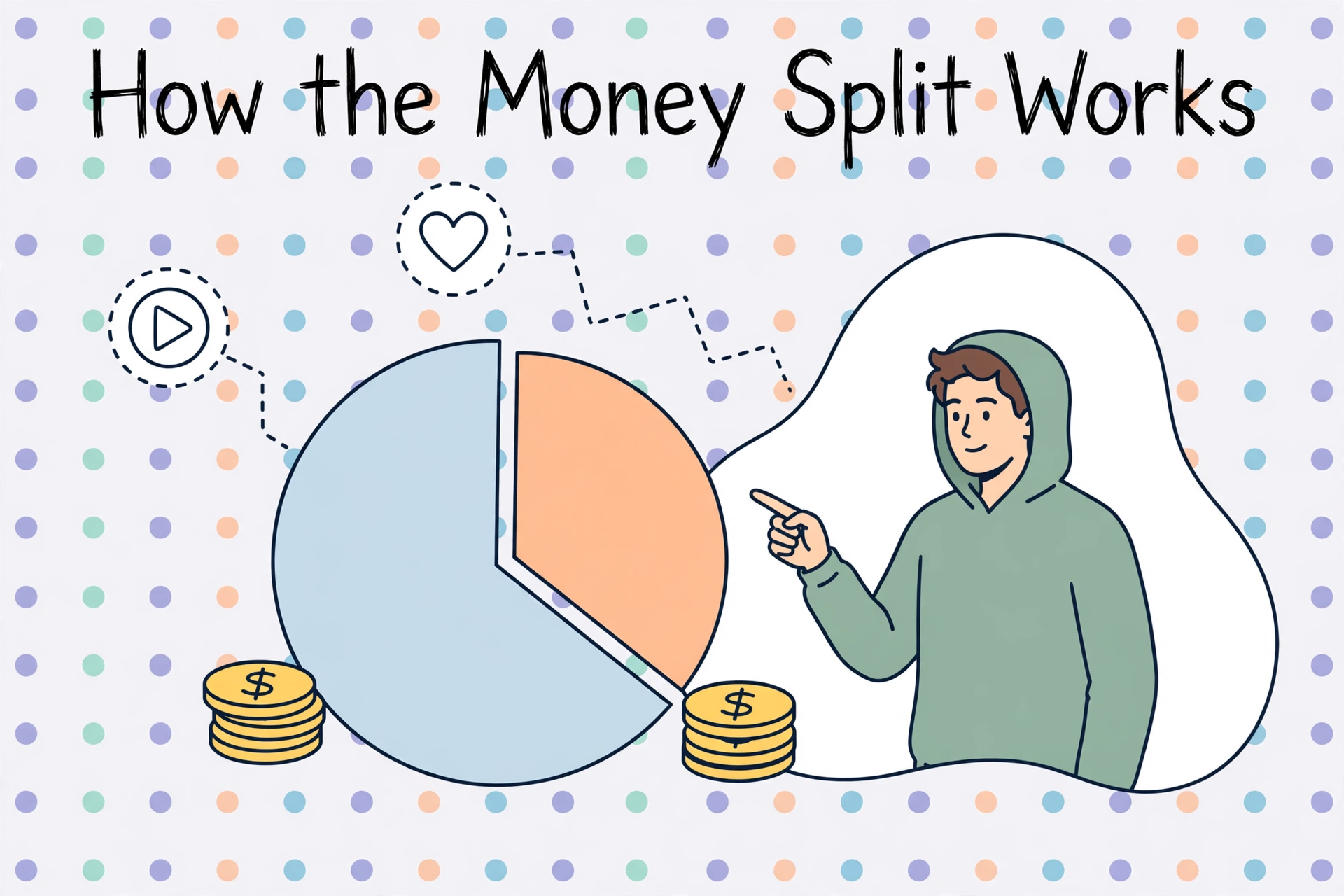
Once you’re in the Partner Program, the split is fixed and public. Under the Watch Page Monetization Module, YouTube pays you 55% of net ad revenue from ads on your videos. Shorts work differently: Shorts ad revenue goes into a shared pool, and creators receive 45% of the revenue allocated to them based on their share of views. Fan funding — channel memberships, Super Chat, Super Stickers, Super Thanks — pays the best rate of all: 70% to the creator.
You’ll see two numbers thrown around, and beginners constantly mix them up:
- CPM is what advertisers pay YouTube for 1,000 ad impressions. It’s the advertiser’s number, before your cut.
- RPM (revenue per mille) is what you actually earn per 1,000 views after the split. This is the only number that matters for your income, and it’s the one YouTube shows you in Analytics.
RPM is always lower than CPM, for three reasons: your 55% share comes off first, not every view shows an ad (some viewers have Premium, some views get no ad at all), and Shorts views are blended in at their much lower rate if you look at channel-wide RPM.
And keep YouTube’s own warning in mind — it’s printed right on the partner earnings page: “There are no guarantees under the YouTube partner agreement about how much or whether you’ll be paid.” Everything below is ranges and examples, not promises. Anyone who tells you a guaranteed per-view rate is selling you something.
Real numbers: what 1,000 views pay in different niches
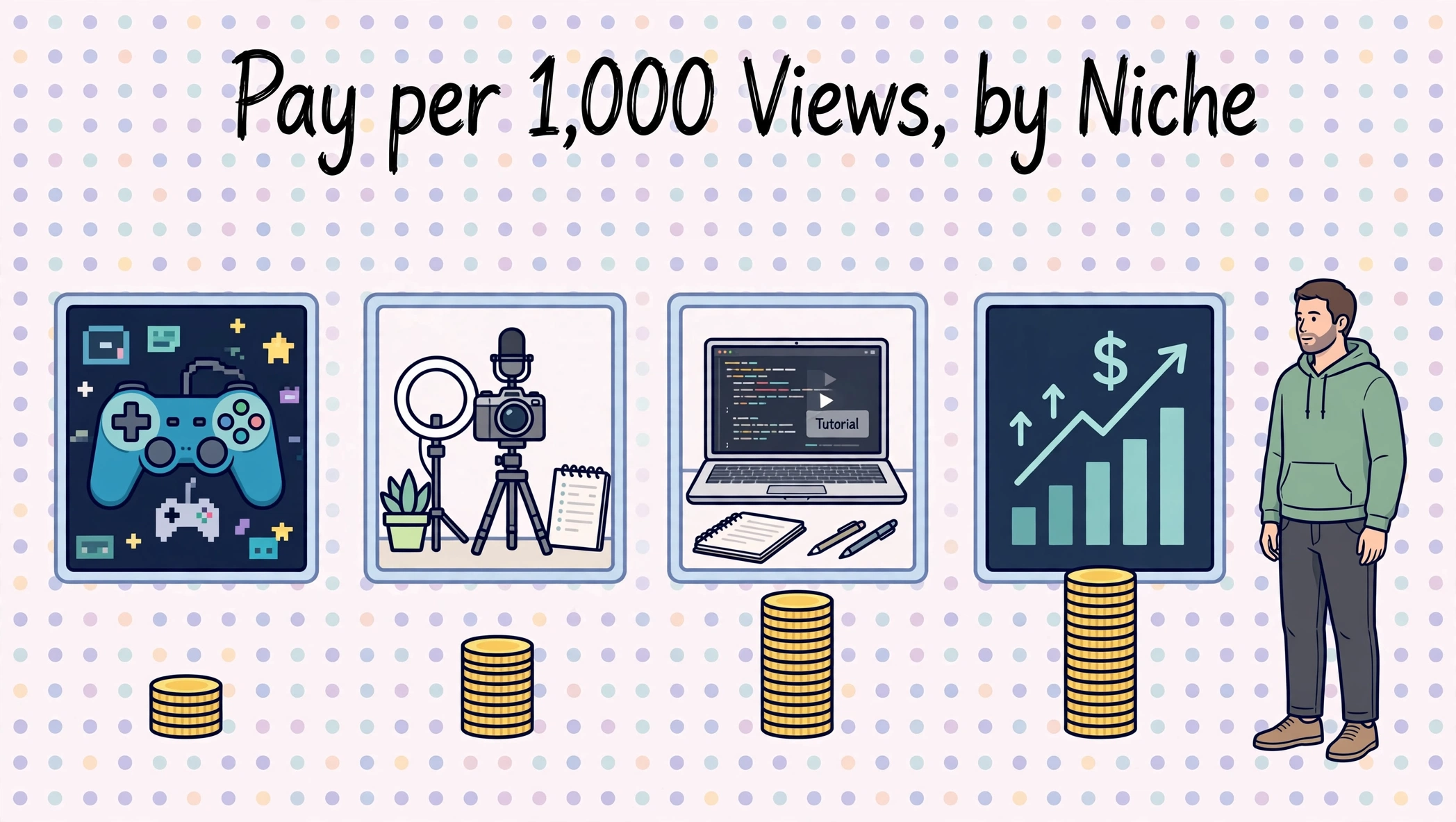
YouTube publishes no official per-view rates, so treat any exact figure you see online with suspicion. What we can do is show the ranges creators most commonly report in their own income breakdowns — these are editorial summaries of widely reported figures, not YouTube data, and your channel can land outside them in either direction:
| Niche (long-form) | RPM creators commonly report | What that means per 100,000 views |
|---|---|---|
| Gaming and general entertainment | $1 – $4 | $100 – $400 |
| Vlogs and lifestyle | $1 – $5 | $100 – $500 |
| Tech reviews and tutorials | $3 – $10 | $300 – $1,000 |
| Education and how-to | $3 – $12 | $300 – $1,200 |
| Business and personal finance | $8 – $25 | $800 – $2,500 |
| Shorts (any niche) | $0.01 – $0.07 | $10 – $70 per 100,000 views |
Why the enormous spread? Advertisers pay for audiences, not views. A finance channel watched by US adults is an audience banks and software companies compete to reach. A gaming channel watched by teenagers in lower-income markets is, to an advertiser, worth much less per view — even if the videos are better. This is also why “how much does YouTube pay per view” has no single answer, and why copying a big creator’s income screenshot tells you almost nothing about what your channel will earn.
Shorts deserve a special note. A million Shorts views sounds enormous, and at the commonly reported $0.01–$0.07 per 1,000 views it pays roughly $10 to $70. Shorts are a discovery tool that can build your subscriber base fast — our guide to getting your first 100 subscribers explains how to use them that way — but long-form is where the ad money is.
Worked examples: what your views could be worth
Let’s do the arithmetic a beginner actually wants. These are examples using the mid-range RPMs above — illustrations, not forecasts:
| Scenario | Math | You earn (approx.) |
|---|---|---|
| 1,000 views on a tech tutorial | 1 × $5 RPM | ~$5 |
| 10,000 views on a vlog | 10 × $3 RPM | ~$30 |
| 50,000 views on an education video | 50 × $6 RPM | ~$300 |
| 100,000 views on a gaming video | 100 × $2 RPM | ~$200 |
| 100,000 views on a finance video | 100 × $15 RPM | ~$1,500 |
| 1,000,000 Shorts views | 1,000 × $0.04 | ~$40 |
The finance-versus-gaming rows are the whole lesson: the same 100,000 views can be worth $200 or $1,500 depending on niche and audience. When we compared blogging vs YouTube for making money, this variance is exactly why YouTube income is so hard to predict in advance — the range isn’t a fudge, it’s the reality of how ad auctions price different audiences.
A realistic first year, month by month
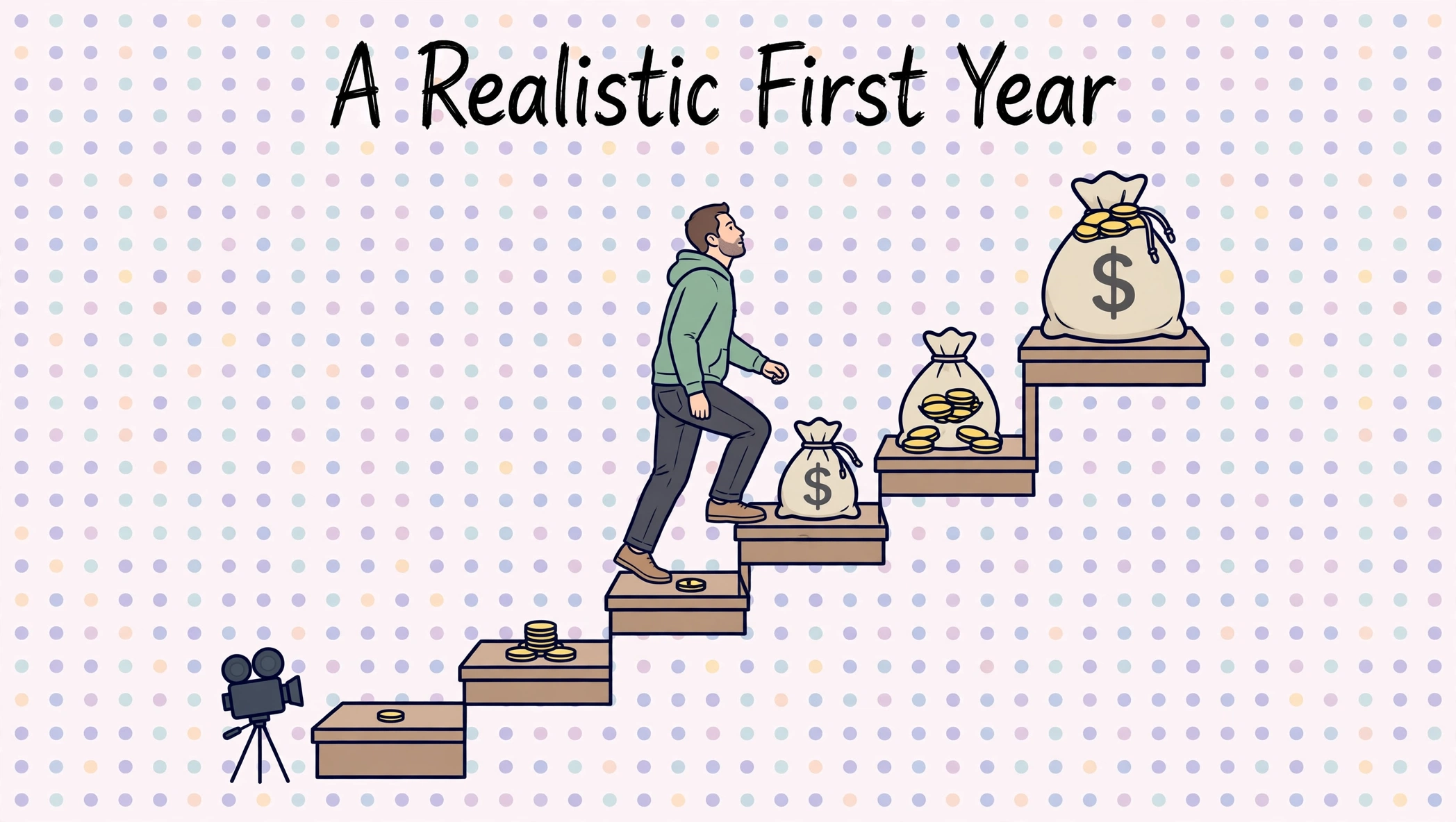
Putting it together, here’s what a typical beginner’s earnings curve can look like. This is an editorial illustration based on the thresholds and ranges above — plenty of channels earn less, some earn more, and timelines vary widely depending on niche, effort, and consistency:
- Months 1–4 (building to monetization): $0. You’re growing toward 1,000 subscribers and 4,000 watch hours. This phase is an investment, and it’s where most people quit — usually one or two months before the math would have started working.
- The month you’re accepted: your back catalogue starts earning at once. A channel with, say, 30,000 monthly views at a $4 RPM sees roughly $120 for the month — often the most motivating money a creator ever earns, because it’s the first.
- Months 6–12: if views keep compounding (each new video adds to the catalogue that earns while you sleep), a small channel might reach $100–$500 a month from ads. Some stall below that; channels in high-value niches with US-heavy audiences can pass it comfortably.
- Around month 12+: this is where the non-ad income usually starts mattering — which is the next section.
The pattern to notice: YouTube ad income for beginners is back-loaded. The first $100 takes months; the second $100 is faster; and the channel’s value is the catalogue, not any single video.
Why two channels with the same views earn completely different money
If your RPM disappoints you, one of these five levers is usually why:
1. Where your viewers live. The single biggest factor. Advertisers pay far more to reach viewers in the US, UK, Canada, Australia and Western Europe than viewers in most other regions. A channel whose audience is mostly in South Asia or Africa will see lower RPMs in the same niche — it doesn’t mean the channel is worse; it means the local ad market pays less.
2. Your niche’s advertiser demand. Finance, insurance, software and business education attract high bids. Entertainment and gaming attract lower bids but far more viewers. Neither is “wrong” — they monetize differently.
3. Video length. Videos of 8 minutes or longer can carry mid-roll ads in addition to the opening ad, so a 10-minute tutorial usually earns more per view than a 4-minute one on the same topic.
4. The time of year. Advertisers spend most heavily in October–December (holiday shopping) and pull back in January. The same channel can see RPMs swing sharply between December and January with identical views.
5. Your Shorts-to-long-form mix. Channel-wide RPM blends everything. A channel that goes viral on Shorts can watch its average RPM fall even while total earnings rise — Shorts views dilute the average while adding only a little revenue.
The money that matters more than ads when you’re small
Here’s the part experienced creators know and beginners miss: for most small channels, ad revenue is not the first real income. These usually arrive earlier and pay better per viewer:
- Fan funding — memberships and Supers pay you 70% (the official rate), and a few dozen loyal viewers can out-earn thousands of casual ad views.
- Sponsorships — a niche channel with 5,000 engaged subscribers in a valuable topic can charge more for one sponsored segment than a month of ads. Brands pay for trust and relevance, not raw size.
- Affiliate income — recommending tools you genuinely use, with honest disclosure, converts well in tutorial and review niches.
- Your own services or products — freelancing, consulting, templates, courses. For many creators this is the real business and YouTube is the marketing. (It’s also the logic behind most AI side-income setups — the channel builds the audience; the offer makes the money.)
None of this makes ads unimportant — they’re the income that scales without your time. But a beginner who builds only for AdSense is ignoring the faster money.
How and when you actually get paid
When the earnings exist, the mechanics are simple, per YouTube’s partner earnings overview: finalized earnings for a month are added to your AdSense for YouTube balance between the 7th and 12th of the following month, and paid out between the 21st and 26th — as long as your balance has reached your local payment threshold and there are no holds on the account. So your first monetized month in, say, March typically lands in your bank in late April.
One tax point that applies to creators everywhere, including Pakistan: Google withholds US taxes on earnings generated from viewers in the United States, and submitting your tax information in AdSense is required for all monetizing creators before payments flow properly. Do it during setup, not after your first payout goes missing.
FAQs
How much does YouTube pay per 1,000 views?
For long-form videos, creators commonly report roughly $1–$10 per 1,000 views in most niches, with business and finance content sometimes higher and entertainment lower. There is no official rate — YouTube pays 55% of net ad revenue on watch-page ads, and what that works out to depends on your niche and audience.
Do you get paid for subscribers?
No. Subscribers themselves pay nothing. They matter because 1,000 of them (plus the watch-time requirement) unlock the Partner Program, and because subscribers watch more of your future videos — which is where the paid views come from.
How much does YouTube pay for 1 million views?
On long-form, at the commonly reported ranges above, roughly $1,000–$10,000 — the niche decides where in that range you land. On Shorts, 1 million views pays far less, commonly around $10–$70, because Shorts revenue comes from a shared pool at a 45% creator share.
Do Shorts views count toward getting monetized?
Yes, through their own path: 10 million qualified Shorts views in 90 days (plus 1,000 subscribers) qualifies you — rising to 20 million for new applicants from February 1, 2027. But Shorts Feed watch hours don’t count toward the 4,000-hour long-form path.
How much do beginners make in their first month on YouTube?
Usually $0 — most channels aren’t monetized yet in month one. After acceptance into the Partner Program, a small channel’s first payouts are typically in the tens of dollars. Treat any first-month figure as the start of a curve, not a salary.
Why is my RPM so low?
Most likely one of the five levers above: viewer geography, niche advertiser demand, short videos (no mid-rolls), a January ad-spend dip, or a high share of Shorts views in the mix. Check YouTube Analytics → Revenue to see RPM by video — the pattern usually explains itself.
How we put these numbers together
Desk research only — we did not run a test channel for this article. The program rules, thresholds, revenue-share percentages (55% / 45% / 70%), payment timeline and tax note were checked on YouTube’s official Help pages and the official YouTube blog announcement on November 7, 2026. The per-1,000-view ranges are summaries of what creators commonly report in public income breakdowns; YouTube publishes no official RPM rates, so we present them as ranges and label them as reports, not platform data.
Final recommendation
So — how much does YouTube pay a beginner? Realistically: nothing for the first few months, tens of dollars a month once you’re monetized and small, and a genuinely meaningful income only when niche, audience geography and a growing catalogue line up. The creators who get there treat the $0 phase as building an asset: pick a niche advertisers value, make long-form videos that stay useful, get monetized before the February 2027 bar doubles if you can, and build the non-ad income (fan funding, sponsors, your own offers) in parallel instead of waiting for AdSense alone.
And keep the official warning taped to your monitor: there are no guarantees about how much or whether you’ll be paid. Channels are a business with variable income, not a payslip — plan for the low end of the ranges, and let anything above it be a bonus.
Article updates
November 7, 2026 — Article published. Partner Program thresholds, revenue shares (55% watch page, 45% Shorts, 70% fan funding), payment timeline and US tax-withholding rule verified on YouTube’s official Help pages; the February 1, 2027 threshold change (8,000 watch hours / 20M Shorts views for new applicants) verified against YouTube’s official blog announcement of August 2026. Per-view earning ranges are labelled in the text as creator-reported figures, not YouTube data.



[…] And YouTube says this in the same document, in plain words: “There are no guarantees under the YouTube partner agreement about how much or whether you’ll be paid.” Hold on to that sentence. It is the most honest line in the whole creator economy. For the YouTube side in full detail — thresholds, revenue shares and realistic first-year numbers — see our breakdown of how much YouTube actually pays beginners. […]
[…] Beyond ads, many creators earn more from sponsorships, affiliate links, and their own products. Our guide to passive income with AI covers digital-product ideas that pair well with a channel, and a blog alongside your channel gives you an audience you fully own. We break down the actual numbers — RPM by niche, worked examples, a realistic first year — in our guide to how much YouTube pays beginners. […]